
Active Warrants in Douglas County
Active warrants in Douglas County come from two main sources. A judge at the Douglas County Combined Courts can sign a warrant during a case. The Douglas County Sheriff's Office, led by Sheriff Darren Weekly, then serves and tracks those orders. A warrant stays active until it is served, recalled, or quashed by the same court that issued it.
No full, public, searchable active-warrant database for Douglas County has been confirmed. The Sheriff warrants page is the official starting point. The court docket should also be checked when a bench warrant came out of a real case, since the file shows the judge, the case number, and any bond tied to the order. Treat any third-party listing as a tip, not proof.
Types of Warrants in Douglas County
Warrants are not all the same. The label tells you who signed it and why. In Douglas County, most warrants fall into one of five buckets, and each one has its own bond rules.
- Arrest warrant - signed by a judge based on probable cause that a person committed a crime.
- Bench warrant - issued by a judge when a person fails to appear, breaks probation, or is held in contempt.
- Search warrant - authorizes a search of a place, person, or property and is often sealed during the active probe.
- Fugitive warrant or hold - involves another state or jurisdiction that wants the person returned.
- Failure-to-comply warrant - tied to unpaid fines, missed classes, missed probation visits, or missed court dates.
Each type can carry a set bond, a no-bond hold, or a bond the judge sets at first appearance. Bond rules are on the Sheriff bonds page.
Arrest Warrant vs Bench Warrant
People often mix up arrest and bench warrants. Both can lead to a trip to the Douglas County jail, but they start in very different places. An arrest warrant grows out of a fresh police case. A bench warrant grows out of a case that is already open.
| Feature | Arrest Warrant | Bench Warrant |
|---|---|---|
| Source | New criminal charge filed after an investigation. | Open case where the person failed to appear or comply. |
| Issued by | Judge or magistrate on probable cause. | Judge presiding over the existing case. |
| Bond | Set by warrant or by judge at first appearance. | Often set by the original case order; may be no-bond. |
| Resolution | Service, booking, advisement, and bond posting. | Voluntary appearance or arrest, then quash or recall by the judge. |
An arrest warrant brings a fast booking and a first appearance. A bench warrant can sit for years until the person is stopped or appears at court. Both should be cleared right away.
How to Search Douglas County Warrants
With no confirmed public active-warrant portal for Douglas County, the search path mixes online checks and direct calls. The Sheriff warrants page is the official jumping-off point. The Colorado Judicial Branch docket helps when the warrant comes out of an open court case.
- Open the Douglas County Sheriff warrants page at dcsheriff.net/warrants/ and read the current instructions.
- If a case number is known, look up the case on the Colorado Judicial Branch docket search for Douglas County.
- Call the Sheriff's Office records line for warrant verification using the contact numbers on the Sheriff site.
- Have the full legal name, date of birth, and any case number ready before any call.
- Ask whether a bond is set and whether the warrant is local, statewide, or extraditable.
- Talk to a lawyer before going in person, since a warrant can lead to arrest at the counter.
- Do not rely on a screenshot, a mugshot site, or a phone tip as proof of the warrant status.
- Keep notes of who was called, the date, and what was said for use at court.
A search through the official channels is free. Neither the Sheriff nor court staff can give legal advice. They can confirm a warrant and tell a person how to surrender or post bond.
The Douglas County Sheriff's warrants page is the official hub for any active warrant question.
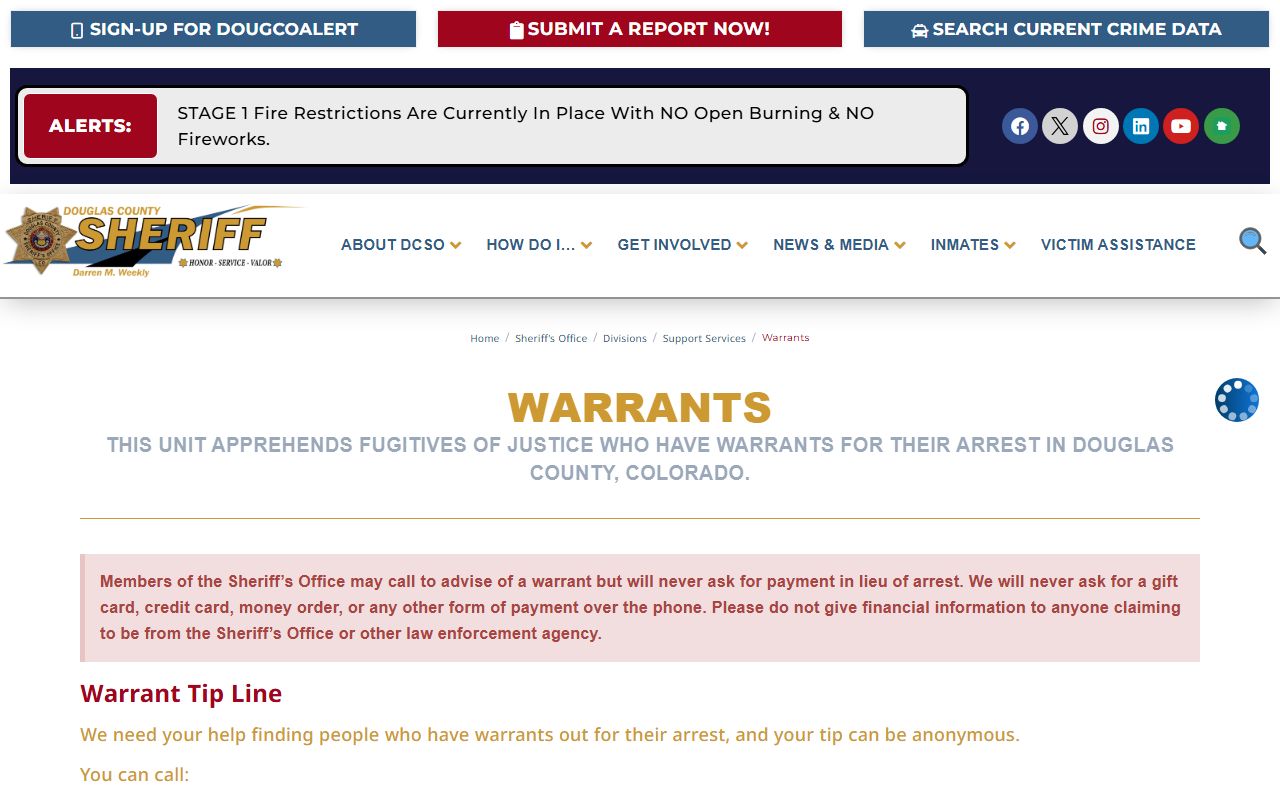
The page above is the one the Sheriff directs Douglas County residents to use for warrant questions and verification calls.
Douglas County Warrant Search Fields
When a warrant check is run by Sheriff or court staff, a few key fields drive the lookup. The field list below reflects the data points that staff ask for during a phone or counter verification. Bring as much of this as possible to speed up the check and to avoid a false match with another person of the same name.
| Field Label | Type | Required | Notes |
|---|---|---|---|
| Name | Text | Unknown | No public searchable portal has been confirmed. |
| Date of birth | Date | Unknown | May be required by staff to verify identity. |
| Case number | Text | Optional | Use the court case number where known. |
| Warrant type | Dropdown | Unknown | Not confirmed by the Sheriff. |
Note: A live phone call or counter visit to the Douglas County Sheriff's Office is the only way the Sheriff confirms a warrant for the public at this time.
What a Douglas County Warrant Record Shows
No public sample active-warrant listing has been released by the Sheriff or the court. The Sheriff warrants page does not post a full set of sample field labels for outside use. Confirm details directly with the agency. Calling the Sheriff warrants line or asking the court clerk at the issuing court is the only way to get a verified set of warrant fields for a real person.
Court-side warrant data may show up on the case docket through the Colorado Judicial Branch docket page as a bench warrant entry. A docket entry can list the warrant date, the judge, and a brief reason, but it is not the warrant itself. The full warrant order may be in the case file and may be available through a court record request using JDF 4.
How to Confirm a Douglas County Warrant
Confirming a warrant is a real step. A tip from family, a docket note, or a bondsman call is not proof. The Sheriff and the court are the only sources that can confirm a warrant is real, still active, and not recalled. Confirm before any surrender, bond payment, or travel that crosses state lines.
Important: Do not rely on unofficial people-search or mugshot sites. Those listings can be old, wrong, or never updated after a warrant is recalled.
Call the Sheriff. If the warrant came out of an open case, also call the court clerk at Douglas County Combined Courts. Ask whether the warrant is still in the system, whether a bond is set, and whether the order has holds from other counties.
What to Do If You Have an Outstanding Douglas County Warrant
An outstanding warrant does not go away on its own. It can show up at a traffic stop, an airport, or a job background check. The next step depends on the type of warrant, the bond, and the charge. A person with a warrant for a serious felony, domestic violence, a protection order, or an out-of-state hold should talk to a lawyer first.
- Confirm the warrant through the Sheriff, the court clerk, an attorney, or an official notice.
- Do not rely on unofficial people-search or mugshot sites for any part of the process.
- Identify the issuing court and the case number.
- Ask whether a bond amount exists or whether the warrant is no-bond.
- Contact an attorney if the warrant involves criminal charges, probation, domestic violence, protection orders, or out-of-state extradition.
- If turning yourself in, ask the Sheriff or court where and when to appear.
- Bring photo ID, case paperwork, medication information, and bond funds if appropriate.
- After resolution, verify that the court recall or quash order has reached law enforcement databases.
The 23rd Judicial District Attorney's office handles the prosecution side of any criminal warrant. Eligible defendants can apply for the Colorado State Public Defender through the court.
Bond on Douglas County Warrants
Bond is the money or pledge that lets a person stay out of jail while the case moves through court. Bond on a Douglas County warrant can be set in the warrant itself, on a bond schedule, or by a judge at first appearance. The Sheriff bonds page is the official source for accepted bond types and posting locations. Posting a bond does not always lead to a fast release if there are holds from another county, the state, immigration, or another agency.
Common bond types in Colorado include cash, surety through a licensed bondsman, property, and personal recognizance set by the court. A no-bond warrant means the person must see a judge first. A cash-only bond will not accept a surety bond. Bond amounts can be high for violent felonies, domestic violence, and failure-to-appear histories.
Warrant Terms to Know
Warrant talk uses words that do not show up in daily life. A short glossary helps a person follow the Sheriff page, the court docket, and a lawyer's advice. Each term below shows up in Colorado warrant practice and on Douglas County paperwork.
- Probable cause
- The legal standard a judge uses to sign an arrest or search warrant.
- Quash
- A court order that voids a warrant, often after a person appears and resolves the issue.
- Recall
- A court action that pulls a warrant back out of law enforcement systems.
- No-bond hold
- A warrant that does not allow release on bond; the person must see a judge first.
- Capias
- A Latin term used for some arrest orders, often for failure to appear or pay.
Restricted Douglas County Warrant Records
Not every warrant is open to the public. Sealed search warrants stay out of view while an investigation is active. Juvenile warrants are restricted under Title 19 of the Colorado Revised Statutes. Federal warrants are not held by the Douglas County Sheriff in any public way. Sealed criminal cases under Title 16 also limit public access. The Chief Justice Directive 05-01 sets the rules for what is public, restricted, or excluded from court records in Colorado.
Sheriff records on warrants fall under the Colorado Criminal Justice Records Act (C.R.S. § 24-72-301 et seq.). That act lets the Sheriff weigh public interest, privacy, and investigation needs. Some warrant data is shared, some is redacted, and some is held back.