
About the Douglas County Court Clerk
Court clerks in Colorado work for the state, not the county. The Douglas County Combined Courts clerk reports up through the Colorado Judicial Branch and the 23rd Judicial District, which covers Douglas, Elbert, and Lincoln counties. The clerk staff sit at the public counter inside the Douglas County Combined Courts at the Justice Center. They are not elected. The Colorado Supreme Court and the State Court Administrator set the rules, fees, and forms the clerk follows.
Day to day, the clerk takes new case filings, accepts payments, prints case dockets, manages the court file, issues subpoenas and writs at the request of parties, sets hearings on the court calendar, and produces plain or certified copies on request. The clerk also runs the front desk for jurors who report for service and helps self-represented filers find the right form. The clerk does not give legal advice. For legal questions, parties are pointed to Colorado Legal Services or the Colorado Bar Association public resources.
Douglas County Combined Courts Clerk
4000 Justice Way
Castle Rock, CO 80109
720-437-6200
Court business hours apply; confirm posted hours at the Justice Center
Two Clerks in Douglas County
This is the most common source of confusion for people searching for the Douglas County Clerk of Court. There are two offices, run by two different units of government, with two different jobs. One handles court files. The other handles land records, marriage licenses, motor vehicle work, and elections. Sending paperwork to the wrong place delays a request by days or weeks, so it helps to know which office does what before you call or drive over.
The state court clerk lives at the Justice Center on Justice Way. The Douglas County Clerk and Recorder lives at the county building on Wilcox Street, a few minutes away in downtown Castle Rock. Both are real, both serve the public, and both are needed. Court cases are state work. Recorded documents and marriage licenses are county work.
For background on the county side, see the Clerk and Recorder page. Here is a quick side-by-side look.
| Office | What it handles | Where |
|---|---|---|
| Court Clerk (Combined Courts) | Court filings, case files, dockets, certified court copies, jury, court payments, JDF forms | Justice Center, 4000 Justice Way, Castle Rock |
| Clerk and Recorder (county) | Recorded land documents, deeds, liens, marriage licenses, motor vehicle, elections, voter rolls | 301 Wilcox Street, Castle Rock |
Need a divorce decree? That is a court file. Go to the court clerk. Need a copy of a deed or a marriage license? That is recording work. Go to the Clerk and Recorder. Probate paperwork is a court file, but a recorded death-related instrument may be at recording. Land judgment liens often live in both places at once.
Douglas County Clerk and Recorder
The county side is worth its own block because users almost always end up needing both offices at some point. The Clerk and Recorder is a county-elected office and runs the Recording Division for land records and other recorded instruments. It is the first stop for deeds, deeds of trust, plats, releases, liens, and judgment liens that have been recorded against real property. It also issues marriage licenses for Douglas County weddings.
Douglas County Clerk and Recorder - Recording Division
301 Wilcox Street
Castle Rock, CO 80104
Recorded land documents, marriage licenses, elections, motor vehicle
The county Recording Division runs an online search tool called LandmarkWeb at apps.douglas.co.us/LandmarkWeb. It is a recorded-document portal, not a court-case portal. You can use it to look up grantor and grantee names, reception numbers, book and page references, document types, and recording dates. It will not show criminal case dockets, divorce case filings, juvenile cases, or court pleadings.
A short lead-in note on the county side: see the Douglas County open records page for the look and feel of the county records portal.
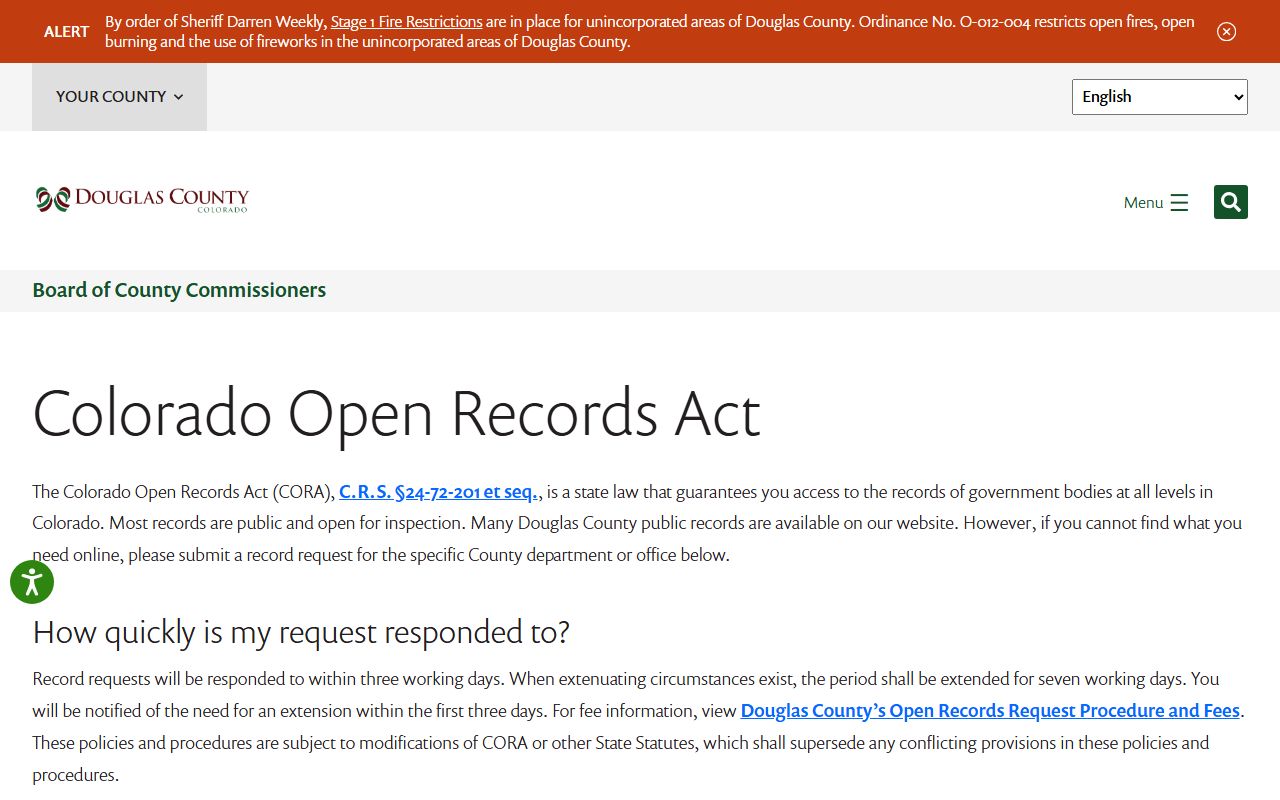
The county open records portal handles CORA requests for county-government records such as budgets, meeting materials, policies, and other non-court records. It is not the place to request court files or sheriff incident reports.
What the Douglas County Court Clerk Does
The Clerk of Court is more than a file room. The clerk is the official keeper of every state-court case in Douglas County. Filings go through the clerk before they reach a judge. Orders pass back through the clerk to be entered on the case. Money paid into a case, whether a filing fee, a fine, a bond, or restitution, runs through clerk staff. Anyone wanting to look up a court file, get a certified copy, file a motion, or pay a court bill goes to the same office.
- Accept new case filings for District Court and County Court
- Keep the official case file and docket for each case
- Issue certified and plain copies of court records
- Take filing fees, court costs, fines, and bond payments
- Issue subpoenas, writs, and other court process at party request
- Set hearings, post the daily court calendar, and call cases
- Manage jury reporting at the Justice Center
Clerks do not pick judges, decide cases, write orders, or tell parties what to argue. They follow Colorado Rules of Civil Procedure, Colorado Rules of Criminal Procedure, and the Chief Justice Directives. If a request runs into a rule, the clerk will point the user to the rule or to a form.
How to Request a Certified Copy from the Douglas County Court Clerk
Certified copies are court copies stamped and signed by the clerk to show they are true copies of the file. They are needed for things like proving a divorce, changing a name on a passport, transferring an estate, filing a foreign judgment in another state, or supporting an immigration application. A plain printout from a free docket search is not the same thing and is usually not accepted by other agencies.
- Identify the case and the court. You need the case number if you have it, the names of the parties, and whether the case is District Court or County Court. The Colorado Judicial Branch docket search can confirm the case number.
- Complete form JDF 4, Request for Records, from the court record and document request page. Fill in court, case number, parties, what records you want, copy type, and how you want delivery.
- Calculate the fee. Plain copy, certified copy, search, and certification fees are set by the Colorado Judicial Branch fee schedule. Bring payment by cash, check, or card as the clerk accepts.
- Submit JDF 4 to the Douglas County Combined Courts clerk in person at the Justice Center, by mail to 4000 Justice Way, Castle Rock, CO 80109, or by other clerk-approved method. Phone or fax submission may be limited.
- Receive the certified copy. Pickup at the clerk window is fastest. Mail delivery follows once payment clears and any redactions are completed. Sealed or restricted material may need a separate court order.
Note: Certified copies are needed for court use in other courts and for many government applications, while uncertified online copies are usually not accepted.
JDF 4 Records Request Form Fields
The state record-request form, JDF 4, is the standard request that the clerk uses. The same field list works for any Colorado state court case, so it pays to learn it once. The clerk will return forms that are missing required fields, which adds days. Fill the form in fully and clearly the first time.
| Field | Required | Notes |
|---|---|---|
| Court / County | Yes | Use Douglas County, 23rd Judicial District where the form asks. |
| Case Number | Strongly recommended | Use the full Colorado case number if known. |
| Case Caption / Parties | Yes if no case number | List the names on the case. |
| Requestor Name | Yes | Person asking for the record. |
| Address | Yes | Mailing address for return delivery. |
| Phone | Yes / as form notes | Used for clerk contact. |
| Yes / as form notes | Used for any electronic response. | |
| Records Requested | Yes | Describe documents, date ranges, or the full file. |
| Copy Type | Yes | Plain, certified, or exemplified copy. |
| Delivery Method | Yes | Pick up, mail, or email as the clerk allows. |
| Signature / Date | Yes | Signs and dates the request. |
Douglas County Court Clerk Fees
The Douglas County court clerk uses the statewide fee schedule set by the Colorado Judicial Branch. Local clerks do not set their own filing fees, copy rates, or certification charges. To see live numbers, check the Colorado Judicial Branch filing fees page before you mail in payment or hand over a check. Fees change from time to time.
Lead-in: see the official state fee schedule page used by Douglas County Combined Courts at the Colorado Judicial Branch filing fees page.
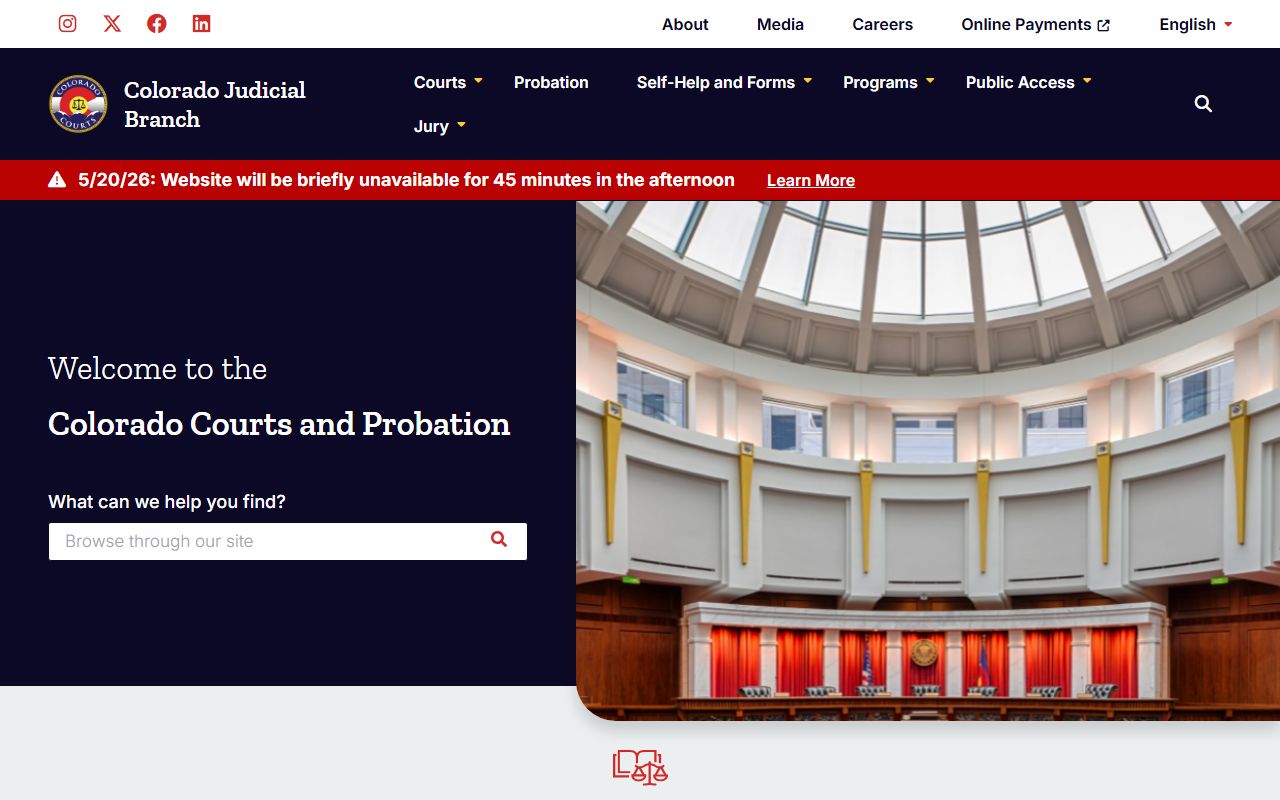
The page lists civil filing fees, family-law filing fees, probate filing fees, small claims and county civil fees, and copy and certification charges. The schedule covers plain copies, certified copies, search fees, and exemplified copies. Filers who cannot afford the fee may apply for a waiver using JDF 205.
| Item | Where to confirm the current amount |
|---|---|
| Plain copy per page | Colorado Judicial Branch fee schedule |
| Certified copy per page | Colorado Judicial Branch fee schedule |
| Certification fee | Colorado Judicial Branch fee schedule |
| Search fee | Colorado Judicial Branch fee schedule |
| Civil filing fee | Colorado Judicial Branch fee schedule |
| Fee waiver - JDF 205 | Available when the filer cannot afford the fee |
Common Forms Used at the Douglas County Court Clerk
The Colorado Judicial Branch publishes a full set of statewide JDF forms. They are the same forms used at every state court clerk window in Colorado. The Douglas County court clerk follows the same set. Coming in with the right form filled out saves a trip back to the parking lot.
- JDF 4 - Request for Records - used to request plain or certified court copies
- Colorado state court forms library - family, civil, probate, protection order, sealing, and other JDF forms
- Colorado Judicial Branch self-help center - instructions and process guides for self-represented filers
Mail, In-Person, and Online Filings
Most filings in Douglas County state court go through the Colorado e-filing system used by attorneys and many self-represented parties. The clerk also takes paper filings at the Justice Center counter and by mail. Court fines and case payments may be made at the clerk counter as well. Confirm what method your case allows before sending paper, because some case types must e-file.
For self-help filers, the Colorado Judicial Branch self-help center has step-by-step instructions, fillable forms, and short videos. For specific case questions, the clerk can point to the right form but cannot tell a party what to file. Mail submissions should include a self-addressed stamped envelope when you want a stamped copy back.