
Colorado Open Records Act and Douglas County Records
The Colorado Open Records Act, found at C.R.S. § 24-72-201 et seq., sets a broad rule that public records held by state and local government are open to the public unless a statute carves out an exception. CORA covers most Douglas County administrative files: budgets, contracts, council and board agendas, emails, meeting minutes, policies, permits, and routine county-government documents. The act applies to the county itself, not to court files at the Justice Center and not to law-enforcement reports at the Sheriff's office. Those two record groups follow different rules.
Under C.R.S. § 24-72-203, the public has the right to inspect public records held by a custodian during normal business hours. The same section sets the response clock and lets the county charge for copies and staff search time when the law allows. A second piece, C.R.S. § 24-72-204, lists the records that can or must be withheld and is the basis for most redactions and denials.
Anyone can file a Douglas County public records request. Residency is not a bar. A reporter, a neighbor, a lawyer, a business, or an out-of-state requester can all file. The county can ask for a written request, can ask the requester to narrow a broad ask, and can charge for the work it takes to fill the request.
Three Public Records Tracks in Douglas County
The single biggest cause of denied or stalled requests is sending the form to the wrong office. Court files held by the Combined Courts are not CORA records. Sheriff incident reports are not CORA records. County contracts and emails are not court records. The table below shows how the three tracks split, with the governing statute, the custodian, and what each track covers. Pick the right track and the request lands at the right desk on day one.
| Track | Governing Statute | Custodian | What's Covered |
|---|---|---|---|
| CORA | C.R.S. § 24-72-201 et seq. | Douglas County, via the open records page | County budgets, contracts, emails, board minutes, permits, policies, and other county administrative records. |
| CCJRA | C.R.S. § 24-72-301 et seq. | Douglas County Sheriff, via the records request page | Arrest reports, jail booking files, incident reports, deputy body-cam where releasable, and other law-enforcement records. |
| Court Records | Chief Justice Directive 05-01 | Clerk of Court, Douglas County Combined Courts | Court case files, pleadings, orders, judgments, decrees, dockets, and certified court copies. |
That split matters in real life. A car crash might generate a deputy report at the Sheriff, a criminal case file at the Combined Courts, and a county risk-management file at the county. One event, three custodians, three forms. Ask who holds the record first, then send the request.
What Douglas County Records the Clerk and Recorder Maintains
The Douglas County Clerk and Recorder is a county elected office, not a court office. It is the place to start for land records, recorded liens, marriage licenses, and other recorded county documents. Recorded files are searched online through LandmarkWeb, the county's recorded-document portal. The portal supports name searches, reception number searches, book and page lookups, and document-type filters. It will not show court case files. For court files, see the court records page.
- Recorded deeds, deeds of trust, and releases of liens
- Plats, subdivision maps, and legal descriptions of real estate
- Recorded judgments, mechanic's liens, and tax liens filed against property
- Marriage licenses and recorded marriage certificates
- Powers of attorney, easements, and other recorded instruments
- Business filings recorded at the county level, where applicable
Court records are different. Divorce decrees, probate filings, civil complaints, criminal case files, juvenile dockets, and traffic case data are held by the state Combined Courts, not by the Clerk and Recorder. For marriage license details, see the marriage and divorce records page. For estate and guardianship files, see the probate records page. Sheriff incident reports, arrest data, and jail booking files are explained on the criminal records page.
How to File a Douglas County Public Records Request
Filing a Douglas County public records request is a written process. The county prefers a written CORA request because it sets the clock and creates a record of what was asked. Walk-in inspection is allowed for some files, but the safer path is to file in writing and let the records custodian set up a time, send the files, or reply with a fee estimate.
- Identify the right custodian. Use the three-track table above. County budget, contract, or email goes to Douglas County under CORA. Sheriff report goes to the Sheriff records page. Court file goes to the Clerk of Court at the Justice Center.
- Write a short, plain request. Name the records you want, the date range, and the format. The clearer the ask, the faster the response. Vague asks often draw a request for more detail.
- Cite CORA. Note that the request is made under the Colorado Open Records Act, C.R.S. § 24-72-201 et seq. The citation signals that the statutory clock and rules apply.
- Acknowledge that fees may apply. State that the requester agrees to pay reasonable copy and search fees and ask for a fee estimate before any charge over a stated dollar amount.
- Send the request to the Douglas County open records page using the contact method posted there. Keep a copy with the date sent.
- Track the response. The custodian must respond within the statutory window. If the county needs more time, it must explain why and give a new date. If the request is denied, the response should cite the statute used.
Douglas County Public Records Statute Block
Three legal sources control the path that any Douglas County public records request takes. Cite the right one and the custodian will route the request properly. The block below pulls the three together in one place.
Colorado Open Records Act (CORA): C.R.S. § 24-72-201 et seq. Governs county administrative records. Use for county-government files.
Colorado Criminal Justice Records Act (CCJRA): C.R.S. § 24-72-301 et seq. Governs arrest and jail records held by the Douglas County Sheriff. Access is more discretionary than CORA.
Chief Justice Directive 05-01: Public Access to Court Records. The official PDF is published by the Colorado Judicial Branch at coloradojudicial.gov. CJD 05-01 controls access to court case files, dockets, and pleadings at the Combined Courts.
The county's open records front door is the Douglas County open records page. That page is the right starting point for any CORA filing. It includes the request channel, the contact route, and the county's own posted notes on fees and timing.
Douglas County Open Records Portal
The Douglas County government posts its CORA process at douglas.co.us/open-records. This is the official county portal for non-court, non-Sheriff records.
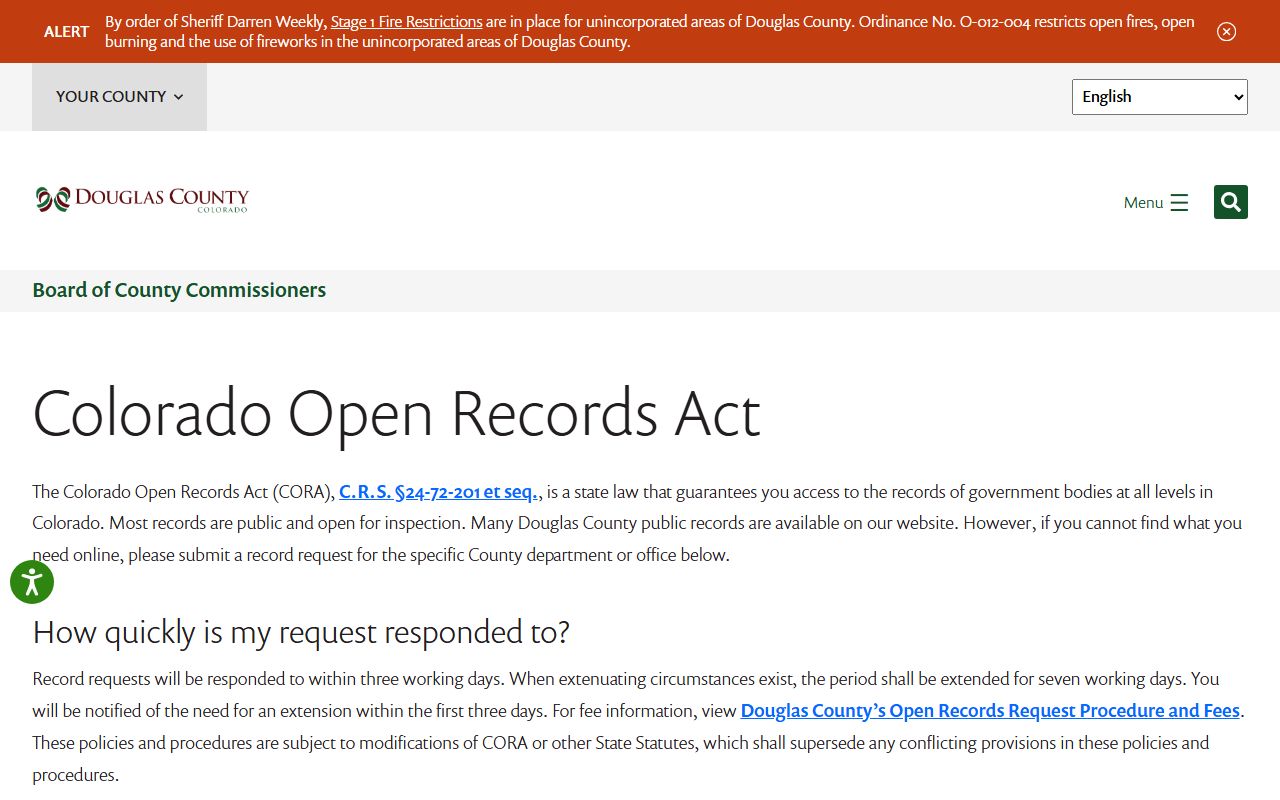
The page lists the contact method, points to the records request channel, and reminds the public that court files and Sheriff files travel through other offices. Use this portal to start a Douglas County public records request for county administrative material.
Public Records Request Form Fields
Most Douglas County public records requests are short. The county needs enough to find the file, enough to know who is asking, and enough to bill copy costs. The field list below covers what the county or any of the three custodians will look for. Skipping a field is a common reason for delay.
| Field | Required |
|---|---|
| Requester name | Yes |
| Mailing address | Yes |
| Phone number | Yes |
| Email address | Yes |
| Description of records requested | Yes |
| Date range of the records | Recommended |
| Format preference (paper, digital, email) | Recommended |
| Delivery method (pickup, mail, email) | Yes |
| Statutory citation (CORA, CCJRA, CJD 05-01) | Recommended |
| Signature and date | Yes |
For Douglas County court records, the state-level form is JDF 4, Request for Records. It asks for many of the same fields, plus a case number, case caption, and copy type. The Clerk of Court at the Combined Courts processes that form.
Douglas County Public Records Fee Schedule
CORA lets the county charge for copy costs and staff search time when the request takes more than a brief look. Actual rates are set by the county and posted on the open records page. The county can also cap the cost at a stated rate per hour for research time. The table below shows the fee categories the law allows; specific dollar amounts are set by Douglas County and should be confirmed on the county page before payment is sent.
| Item | Amount |
|---|---|
| Per-page paper copy | Rate set by Douglas County; see open records page |
| Staff research time, per hour | Rate set by Douglas County under CORA limits |
| Electronic delivery (email, link) | Often no copy charge; may include staff time |
| Certified court copies (JDF 4) | Set by the Colorado Judicial Branch fee schedule |
| Sheriff record copies | Set by the Douglas County Sheriff records office |
A fee waiver is possible in narrow cases when the public interest is strong, but waivers are not routine. Best practice is to ask for a written cost estimate before the work starts. For Douglas County court copies, the Judicial Branch publishes a separate fee schedule. See the Clerk of Court page for court copy details.
Note: A CORA request that asks for a narrow set of files and a clear date range usually costs less than a sweeping ask that pulls years of email.
Response Timelines for Douglas County Public Records
Under CORA, the custodian must respond within three working days of getting the request. The clock starts when the request is received. If the records are not in the office, are stored offsite, or require a careful search, the custodian can extend the time by up to seven more working days in cases of extenuating circumstances. The custodian must give the reason for the delay in writing and set a new date for the response.
CCJRA timing for Sheriff records is different. The Sheriff has more discretion to balance public interest, ongoing investigation, victim privacy, and other factors. Court record requests through the Clerk of Court at the Justice Center follow Judicial Branch processes and CJD 05-01; certified copies and archived files may take longer than a same-day request at the counter.
If the custodian misses the deadline, that fact can support a later legal challenge. Most delays end with a full or partial release. A flat denial should cite the statute used.
Records That Are Exempt or Restricted
CORA lists records that can be withheld under C.R.S. § 24-72-204. Some are flat bars; others let the custodian weigh the interests. Common exempt categories include personnel files with private personal information, medical records, child welfare files, security plans, attorney-client privileged material, trade secrets in a county-held file, and certain investigative records. Juvenile court files, adoption records, sealed criminal cases, and grand jury material are restricted by other Colorado statutes and by court rule.
Court rules add their own layer. CJD 05-01 names what is public, what is restricted, and what is fully off-limits at the court counter. Social Security numbers, account numbers, and other personal identifiers are redacted before release. Where only part of a record is exempt, the custodian should redact the exempt parts and release the rest.
Colorado Public Records Law for Douglas County
The Colorado General Assembly posts the full text of CORA, CCJRA, and other state laws at the Colorado Revised Statutes page. Title 24 is the home of both records acts.
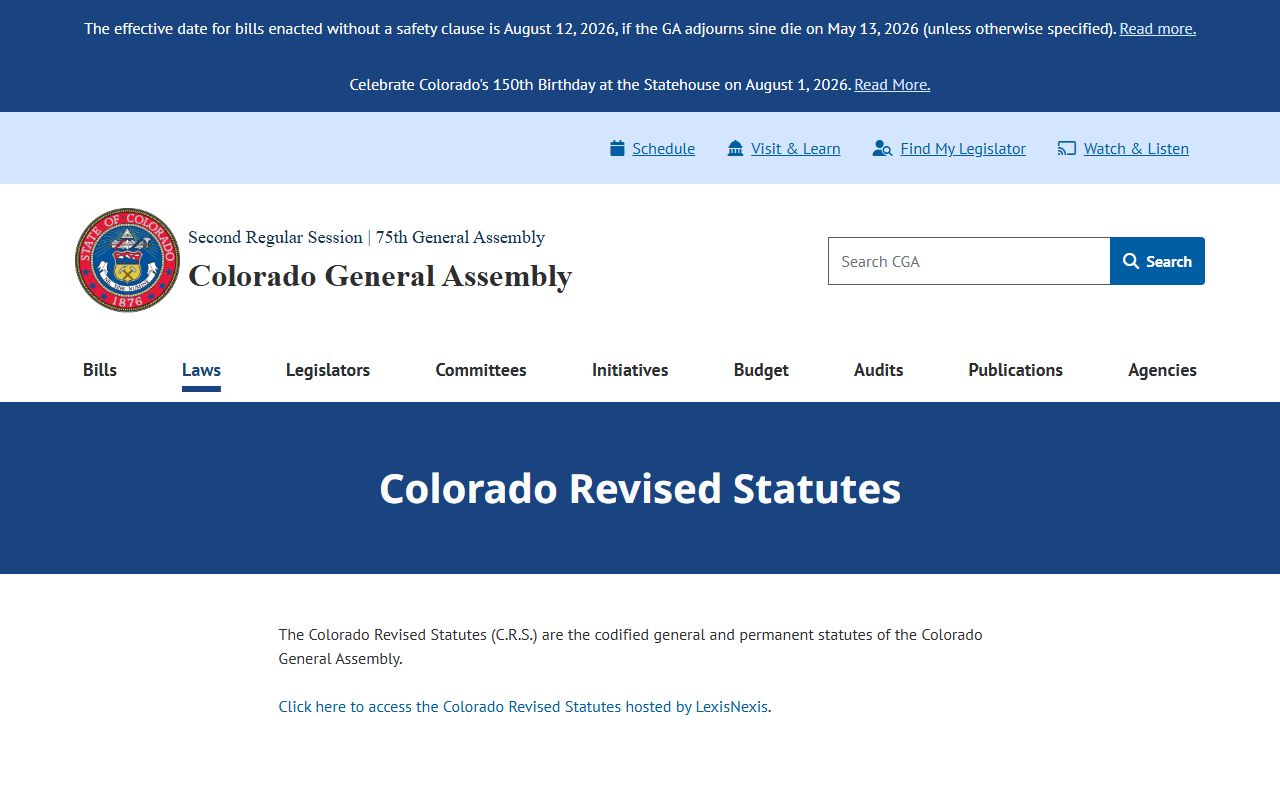
Reading the statute first is a fast way to know whether a Douglas County public records request is likely to succeed. The text spells out who is a custodian, what counts as a public record, and what the custodian can charge or withhold.
If a Douglas County Public Records Request Is Denied
A denial is not the end of the road. The custodian must give a written reason and cite the statute. The next step is often a request for a meeting or a letter asking the custodian to reconsider. CORA also allows a denied requester to file in district court for an order to make the record public. The court can review the custodian's reason and order release if the law does not support the denial.
For Sheriff records denied under CCJRA, the court can review the Sheriff's discretion. For court files denied under CJD 05-01, the path runs through the court itself, often as a motion to unseal or a request to the Chief Judge. Legal aid groups, including Colorado Legal Services and the Colorado Bar Association public resources, can point a person to a lawyer who handles records cases.
Public Record Search
Sponsored Results