
Douglas County District Court Overview
The District Court is the main court of general jurisdiction for Douglas County. It hears felony crimes, larger civil cases, divorce and family law, juvenile, probate, and mental health cases. The court is a state court. The Colorado Judicial Branch runs day to day operations, not the county. Douglas County shares the Justice Center campus in Castle Rock with the Sheriff and other county offices.
Each case gets a Colorado case number, a judge or magistrate, and a courtroom in the Justice Center. Most hearings are open to the public, but some kinds of cases (juvenile, adoption, mental health) are closed by law. The clerk window at the Justice Center is where most public requests start. The 23rd Judicial District was carved out so Douglas, Elbert, and Lincoln counties could have their own bench, district attorney, and probation team. Before the split, those counties were part of the 18th Judicial District.
Douglas County Justice Center and Combined Courts
The Justice Center at 4000 Justice Way in Castle Rock is the home of the Douglas County Combined Courts. The same building holds both the District Court and the County Court. The clerk's office, the jury room, the bond window, and most of the courtrooms are inside. The Sheriff and the detention facility share the same campus. For a quick view of where the building sits, see the Google Maps location for 4000 Justice Way.

The map shows the Justice Center off Justice Way, west of downtown Castle Rock and close to Interstate 25. Most people drive in. Plan extra time for parking and for the security screen at the door.
Douglas County Combined Courts
District Court and County Court
4000 Justice Way
Castle Rock, CO 80109
Phone: 720-437-6200
Court hours: Posted business hours, weekdays
Bring a photo ID for anything at the clerk's counter. Court staff cannot give legal advice. They can show you the file, take a filing, accept a fee, and stamp a certified copy. For most other questions, the Colorado Judicial Branch self help center is a better first stop.
Douglas County District Court Office Table
Colorado does not number its district court divisions the way some other states do. Instead, the Combined Courts share staff and rooms at the Justice Center and split the work by case type. The table below lists the main court and clerk offices that serve Douglas County, plus the local Municipal Courts that handle city ordinance cases. Phone numbers for city courts run through the city or town that runs them.
| Court / Office | Address | Phone | Jurisdiction / Role |
|---|---|---|---|
| Douglas County District Court | 4000 Justice Way, Castle Rock, CO 80109 | 720-437-6200 | Felonies, civil, domestic relations, probate, juvenile, mental health. |
| Douglas County Court | 4000 Justice Way, Castle Rock, CO 80109 | 720-437-6200 | Misdemeanors, traffic, small claims, county civil, protection orders. |
| Douglas County Combined Courts Clerk | 4000 Justice Way, Castle Rock, CO 80109 | 720-437-6200 | Court filings, case records, dockets, copy requests, payments. |
| 23rd Judicial District Probation | Through Colorado Judicial Branch | Court phone | Supervises sentenced or court ordered cases for Douglas, Elbert, Lincoln. |
| Castle Rock Municipal Court | Town of Castle Rock | Town phone | Castle Rock ordinance violations. |
| Parker Municipal Court | Town of Parker | Town phone | Parker ordinance violations. |
| Lone Tree Municipal Court | City of Lone Tree | City phone | Lone Tree ordinance violations. |
| Castle Pines Municipal Court | City of Castle Pines | City phone | Castle Pines ordinance violations. |
If you got a ticket inside the limits of Castle Rock, Parker, Lone Tree, or Castle Pines, check the city first. Many minor cases never make it to the Justice Center because the city court keeps them. State and county case dockets show through the Colorado Judicial Branch docket search.
Douglas County District Court Jurisdiction
The District Court is a court of general jurisdiction. It can hear almost any kind of case the state can hear, unless a statute hands the case to a different court. In Douglas County, the same building hears both District and County Court cases. The court split happens by the type of case, not by address. A driver charged with a DUI may show up in County Court for the first appearance and then move to District Court if filed as a felony. The clerk at the front counter can point a visitor to the right window.
Common District Court Case Types
The list below is a quick view of the work that fills most dockets.
- Felony criminal cases, from class 6 to class 1.
- Civil suits above the County Court money limit.
- Divorce, legal separation, and allocation of parental responsibilities.
- Probate of wills, intestate estates, trusts, and guardianships.
- Juvenile delinquency, dependency, and neglect.
- Mental health commitments and treatment orders.
- Adult name changes and civil protection orders within District Court rules.
Douglas County District Court vs County Court vs Municipal Court
The biggest source of confusion for the public is which court holds which case. The split is set by state law and city charter, not by what people call the court. The table below sets the three trial courts side by side so it is easy to see who hears what.
| District Court | County Court | Municipal Court | |
|---|---|---|---|
| Main jurisdiction | General jurisdiction, state court. | Limited jurisdiction, state court. | City ordinance court, local. |
| Case types | Felonies, civil, divorce, probate, juvenile, mental health. | Misdemeanors, traffic, small claims, county civil, protection orders. | City code, parking, animal, noise, low level traffic. |
| Location | Justice Center, 4000 Justice Way, Castle Rock. | Justice Center, 4000 Justice Way, Castle Rock. | City hall in Castle Rock, Parker, Lone Tree, or Castle Pines. |
| Appeals go to | Colorado Court of Appeals. | District Court (then Court of Appeals). | District Court for a new trial. |
Note: A case can switch tracks. A felony filed in County Court for the first appearance can be bound over to District Court once the charge is set, and a civil case that looks small at first can be re filed in District Court if the damages grow.
How a Case Moves Through the Douglas County Court System
Most people only see one or two steps of a case. The full path can run from a city ticket all the way to the state's top court. The flow below is the long version. Most cases stop well before the end.
Flow: County Court or Municipal Court › Douglas County District Court › Colorado Court of Appeals › Colorado Supreme Court
- A case starts with a ticket, an arrest, a civil filing, or a family law petition. The court of first filing depends on the case type.
- If the case is in County Court or in a Municipal Court, the trial happens there. Most low level cases end at this step.
- If the case is a felony, a divorce, a probate, or another District Court matter, it moves to the District Court at the Justice Center for hearings, pretrial work, and trial.
- A party who loses can file an appeal. Most appeals from Douglas County go to the Colorado Court of Appeals. Some go straight to the Colorado Supreme Court when the law says so.
- The Court of Appeals can affirm, reverse, or send the case back. Either side may then ask the Colorado Supreme Court to take the case.
- Federal claims are different. A federal civil rights case, a federal crime, or a federal question case is filed in the U.S. District Court for the District of Colorado. Federal appeals go to the Tenth Circuit.
For day to day case lookup, the Douglas County court dockets page covers how to read the daily calendar. For older case files, the court records page walks through copy requests.
Douglas County District Court Divisions
The Combined Courts split work into civil, family, criminal, probate, and juvenile divisions. Each division has its own docket and often its own judge. A divorce filer does not stand in the same line as a felony defendant. The Colorado Judicial Branch page for the county is the safest place to check who is sitting on a case.
Civil covers money damages, property, and contract cases above the County Court limit. Family covers divorce, legal separation, parenting time, child support, and post decree motions. Criminal covers felony charges, plea hearings, and trials. Probate covers wills, estates, trusts, guardianships, and conservatorships. Juvenile covers delinquency, dependency, neglect, and some adoption work.
For deeper looks at each record type, see the criminal records page for the criminal side, the probate records page for estates, and the traffic court records page for tickets.
23rd Judicial District
Douglas County sits inside Colorado's 23rd Judicial District. The district was carved out of the older 18th Judicial District so that Douglas, Elbert, and Lincoln counties would share a bench, a district attorney's office, and a probation team. The 23rd is one of Colorado's newer judicial districts. It went live so the area would have its own court resources instead of sharing with Arapahoe County. The chief judge and the district administrator set the local rules, scheduling, and many of the standing orders that govern how cases move.
The fees that show on a filing in Douglas County are state fees set by the Colorado Judicial Branch. To see the current schedule, view the Colorado Judicial Branch filing fee page.
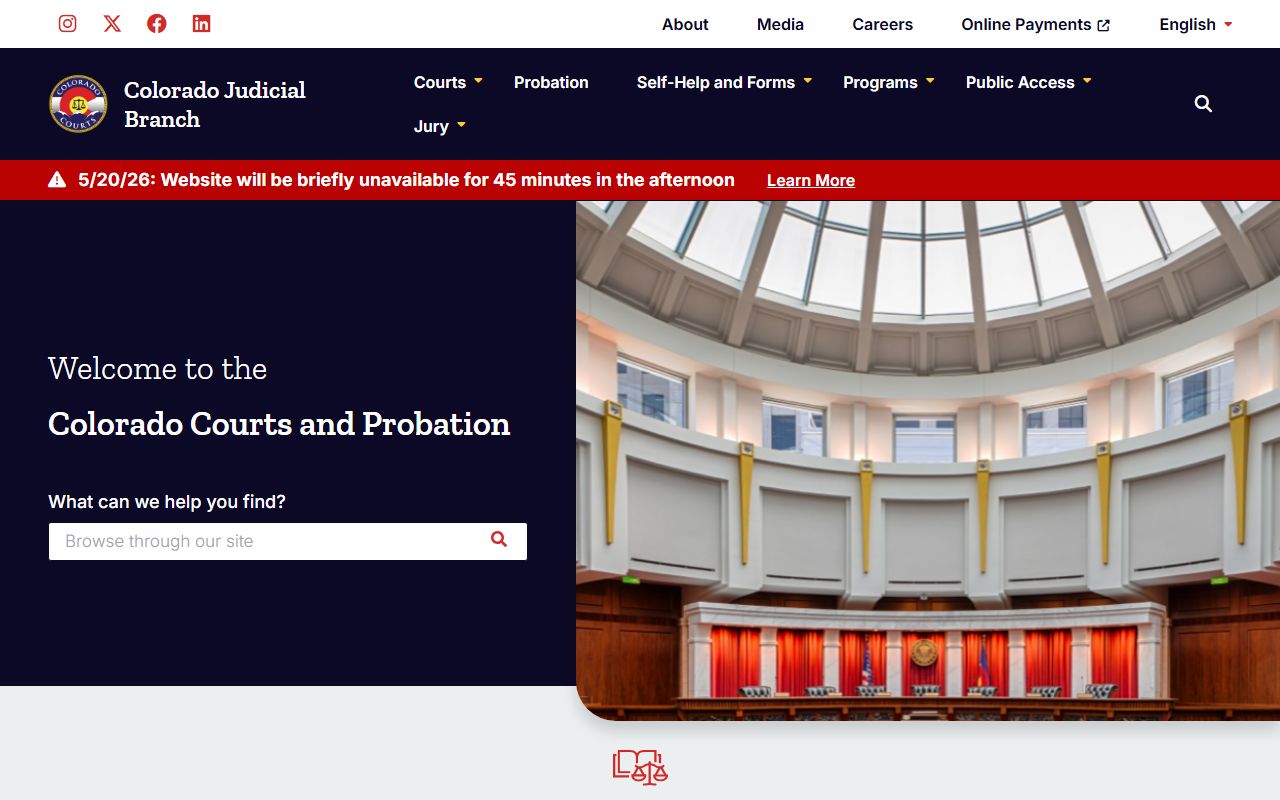
The fee page shows the current civil, family, probate, and small claims filing fees that apply at the Justice Center. Fee waivers are possible through JDF 205 for filers who cannot pay, and the clerk can hand out the form at the counter.
The 23rd Judicial District Attorney prosecutes felony cases at the Justice Center. The state public defender covers indigent felony defense. Both offices file daily at the District Court clerk's window.
Specialty Courts and Problem Solving Dockets
Colorado allows trial courts to run problem solving dockets that focus on treatment instead of jail. Common types are adult drug court, DUI court, veterans treatment court, mental health court, family treatment court, and juvenile treatment court. These dockets bring the judge, the district attorney, defense counsel, probation, and a treatment team together to manage a case through frequent reviews. The point is to reduce repeat arrests and to give the person tools to stay out of the system.
For Douglas County, the public roster of active specialty dockets is not fully posted on the official court page. A full list of programs, judge names, and graduation rates was not in the official sources used for this build. The safe path is to ask the clerk or a defense lawyer if a given case may fit a treatment track. The court, the DA, and probation staff make the call on who can enter.
For broader access help, the state self help center and Colorado Legal Services offer free or low cost legal aid. The Colorado Bar public resources page lists more help by topic.
Appeals from Douglas County District Court
A losing party in District Court can appeal to the Colorado Court of Appeals. The notice of appeal must be filed within the time set by Colorado Appellate Rules. The Court of Appeals usually decides cases on the written record and briefs, with oral argument when needed. A party who loses there can ask the Colorado Supreme Court to take the case, but the Supreme Court picks which cases it hears.
County Court cases take a different first step. A party who loses in County Court appeals to the District Court for a fresh look. Municipal Court cases also start their appeal in the District Court for a new trial. Federal questions go to the federal system instead: a federal crime, civil rights case, or federal statute case is filed at the U.S. District Court for the District of Colorado, with appeals to the Tenth Circuit in Denver.