
Getting a Douglas County Marriage License
Marriage licenses in Douglas County are not handled by a court clerk. They are issued by the Douglas County Clerk and Recorder, an elected county office that also runs elections, motor vehicle services, and land recording. The recording division sits at 301 Wilcox Street in Castle Rock, and the marriage license counter is part of that same county office. Couples planning a ceremony anywhere in Colorado may apply through this office, since a Colorado license issued by any county clerk is valid statewide.
Eligibility under Colorado law is straightforward. Both parties must show valid government-issued photo ID. Colorado does not require a blood test. There is no statewide waiting period once the license is issued, so a couple can apply and marry the same day if their schedule allows. Anyone who was married before must report the date the prior marriage ended, by divorce or by death. The county marriage license page lists the current license fee and any payment rules, so check that page before driving to the counter. Do not rely on outdated fee figures from other sites.
Colorado still recognizes common-law marriage. It is formed by mutual consent and a holding-out as a married couple, not by a county license. A court may need to confirm the union later when a divorce, estate, or benefits issue arises. For most couples a recorded ceremonial license is far simpler.
How to Apply for a Marriage License in Douglas County
The process moves fast when both parties bring the right ID and a way to pay. Read the county page first, then plan to appear together at the counter. Both parties must sign in person under Colorado law, with limited exceptions handled through the clerk's office.
- Review the Douglas County marriage license page for current hours, fee, and any online pre-application option.
- Complete the online pre-application if the county offers one for your visit. This saves time at the counter and reduces typos on the recorded license.
- Bring valid government photo ID for both parties, plus proof of any prior marriage ending if asked.
- Appear together at the Clerk and Recorder counter at 301 Wilcox Street and sign the application under oath.
- Pay the license fee as posted on the county page. Confirm accepted payment methods before you arrive.
- Receive the license. There is no Colorado waiting period, so the ceremony may take place the same day.
- Have the ceremony performed by an authorized officiant, or use Colorado self-solemnization where the couple solemnizes their own marriage.
- Return the signed license to the Clerk and Recorder within the statutory return window so the office can record it and issue certified copies.
Note: Same-day issuance is the norm, but counter staffing and lunch closures can slow things down, so plan extra time near month-end or summer wedding peaks.
Marriage License Application Fields
The license application asks for facts about both parties, prior marriages, and how the couple will solemnize the union. The table lists each field as captured from the marriage license process, with notes on what staff expect to see at the counter.
| Field | Required | Notes |
|---|---|---|
| Applicant 1 legal name | Yes | Full legal name as it appears on government ID. |
| Applicant 2 legal name | Yes | Full legal name as it appears on government ID. |
| Date of birth | Yes | Proof of age and identity required for each party. |
| Address | Yes | Current residence for each party. |
| Phone or email | Yes or optional | Used for appointment, status updates, or pickup contact. |
| Identification | Yes | Government-issued photo ID. Confirm the accepted list on the county page. |
| Social Security number | If applicable | Collected per law and not displayed on the public record. |
| Prior marriage status | Yes | Date and manner each prior marriage ended, by divorce or death. |
| Ceremony date or officiant | Optional | Filled in before or after the ceremony, depending on the path used. |
| Signature and oath | Yes | Both parties sign and certify eligibility under Colorado law. |
Once the recorded license is back on file, the Clerk and Recorder can issue certified copies for name changes, immigration, Social Security, employer records, and benefits paperwork.
The current Douglas County marriage license page lists hours, fees, and the in-person process used at the Clerk and Recorder counter.
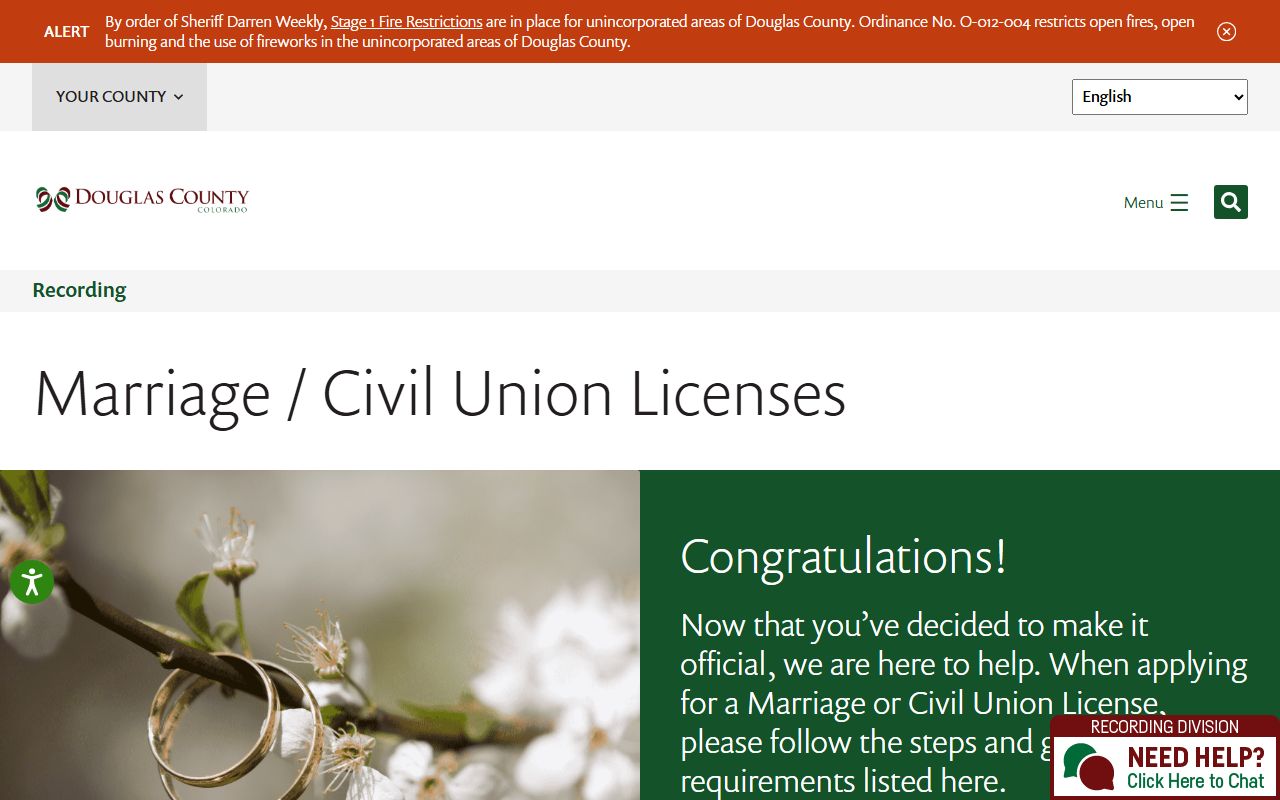
The page is the only place to confirm the current license fee, so check it the day before you plan to apply.
How to Look Up Douglas County Marriage Records
Once a license is recorded, the marriage record stays with the issuing county. For a Douglas County license, that means the Clerk and Recorder holds the file and issues certified copies. Most counter requests can be filled the same day if the clerk has the date or a name. Older licenses may take a longer pull from archive storage, especially if the request goes back several decades.
To request a marriage record copy, the clerk usually wants both parties' legal names at the time of marriage, the date of the ceremony if known, and the requestor's ID. State law restricts who may receive a certified copy of a marriage record, so a relative, spouse, or party to the marriage will have an easier time than a casual researcher. Plain informational copies may be available under different rules. The county page lists the current fee and any mail-in instructions.
Statewide context helps too. Colorado vital records are coordinated by the Colorado Department of Public Health and Environment, which maintains the state marriage index. For a license issued in Douglas County, the record itself stays in Castle Rock with the local Clerk and Recorder.
How to Find Douglas County Divorce Records
Divorce records are court records, not county-clerk records. A Colorado divorce is filed as a Dissolution of Marriage case in District Court. In Douglas County, that means Douglas County Combined Courts at the Justice Center, 4000 Justice Way in Castle Rock. The state court clerk at that address keeps the file, not the Clerk and Recorder. Certified copies of a Douglas County divorce decree come from the court clerk, not the county recorder.
To find a case, start with the Colorado Judicial Branch docket search. A docket hit confirms the case number, court, and hearing dates. Then submit a court record request using JDF 4 to the Douglas County Combined Courts clerk. The clerk can pull the case file, charge a copy fee, and issue plain or certified copies. Older cases that are no longer on the active shelves may need archive retrieval, which adds days to the wait.
A typical divorce file may hold the petition, summons, sworn financial statements, a parenting plan, child-support worksheet, separation agreement, permanent orders, the decree itself, and any post-decree motions. Some pieces, like financial schedules and child-related exhibits, are restricted or redacted under Chief Justice Directive 05-01 and Title 14 of the Colorado Revised Statutes. The case caption and the decree are usually public, but the financial pages and parenting plans often are not.
Anyone planning to file a new divorce should use Colorado Judicial Branch divorce forms and review the self-help instructions before filing. A walk-through follows.
- Confirm Colorado residency under Title 14 and the Judicial Branch self-help materials. Residency must be met before the case can move forward.
- Pick the right forms from the Judicial Branch self-help library. The forms differ for cases with children, without children, and joint petitions.
- File the petition in Douglas County District Court at 4000 Justice Way if venue is proper for either party.
- Pay the filing fee at the counter, or submit JDF 205 to ask the court to file without payment based on a sworn financial affidavit.
- Serve the other party with the petition and summons, unless the case is a joint filing where both parties sign at the start.
- Complete sworn financial disclosures, any parenting class for cases with children, and any mediation the court orders.
- Appear for status conferences, temporary orders if needed, and the permanent orders hearing.
- Receive the signed decree, then request certified copies from the Douglas County Combined Courts clerk for name changes, retirement plan orders, or other follow-up uses.
Getting Certified Douglas County Marriage and Divorce Copies
Certified copies carry the issuing office's seal and a clerk signature. Most legal uses, including name changes, Social Security updates, passport applications, immigration filings, and survivor-benefit claims, require a certified copy rather than a plain printout. A screenshot from a docket or a phone photo of a paper decree will not be accepted by these agencies.
For a marriage license, the certified copy comes from the Douglas County Clerk and Recorder at 301 Wilcox Street. For a divorce decree, the certified copy comes from the Douglas County Combined Courts clerk at the Justice Center. Bring photo ID, the case or license number if available, and payment for the copy fee posted by each office. Mail requests are accepted but take longer, and the requester usually needs to enclose a self-addressed return envelope along with payment.
Colorado Vital Records Context
Colorado handles vital records through the Colorado Department of Public Health and Environment Vital Records office. That state office maintains the central index of births and deaths and helps locate Colorado marriages when the county of issue is unknown. For a marriage license that is known to have been issued in Douglas County, the certified copy still comes from the local Clerk and Recorder rather than from the state office. The state office is most useful when the county of issuance is unclear, or when a researcher is tracing a marriage that crossed counties.
Douglas County Clerk and Recorder
Recording Division
301 Wilcox Street
Castle Rock, CO 80104
Marriage licenses, recorded documents, elections, motor vehicle
Douglas County Combined Courts
Justice Center
4000 Justice Way
Castle Rock, CO 80109
720-437-6200
Divorce, custody, decree certified copies
The Clerk and Recorder also runs the Douglas County recording division, which is the same office that issues and stores marriage licenses.
That overlap is why a marriage license request and a recorded-deed request can both be handled at the same Wilcox Street counter, while divorce decrees stay at the Justice Center.