
Criminal Records in Douglas County
Criminal records in Douglas County come from three sources. The Douglas County Sheriff books arrestees at the detention center on the Justice Center campus in Castle Rock. Local police in towns like Parker, Castle Rock, and Lone Tree run their own incident reports and pass arrest paperwork to the Sheriff or directly to the courts. Once charges get filed, the Douglas County Combined Courts open a case file. Felonies move to District Court. Misdemeanors and most traffic crimes move to County Court. Sheriff Darren Weekly leads the agency that handles booking, jail, and warrants.
An arrest record is not the same as a court record. An arrest record starts at booking and shows name, charges at intake, mugshot, and bond amount. A court file starts when the District Attorney files a charging document. The court file holds pleadings, motions, plea forms, sentencing orders, and the final disposition. A conviction record is a third thing. It is the formal court entry of guilt after a verdict or plea. A person can have an arrest with no charges filed. A person can have charges filed but no conviction. All three live in different drawers.
This split matters when you want a full picture. A criminal background lookup that only checks one source misses key facts. Sheriff data without court data may show a booking but not the dismissal. Court data without sheriff data may show the case but skip the arresting agency notes. The 23rd Judicial District spans Douglas, Elbert, and Lincoln counties, so a case caught in one county can show up on a docket linked to neighbors. For full records access, plan to check both the Sheriff and the state court docket.
How to Find a Douglas County Criminal Case
The main free tool for court case lookups is the Colorado Judicial Branch dockets page. It shows hearing dates, courtrooms, and case numbers across every state court, including Douglas County District Court and County Court. The docket tool will not return full filings. For pleadings, orders, and certified copies, use the JDF 4 record request form through the court clerk at the Justice Center. Below is the basic walkthrough for a name-based criminal search.
- Open the Colorado Judicial Branch dockets page and select Douglas County from the county dropdown.
- Pick a date or a date range. Use a wide range if you are not sure when a hearing was set.
- Pick the court. Choose District Court for felony cases and County Court for misdemeanor or traffic crimes.
- Enter the party name. Try the full last name first. Add a first name if results are too long.
- Read the result list. Note case number, case caption, hearing type, courtroom, and judge.
- For full documents, file JDF 4 with the Douglas County Combined Courts clerk and pay any copy fee.
For an arrest report or booking detail, go to the Sheriff. The records request page sits at dcsheriff.net/records. That page lists what the agency can release under the Colorado Criminal Justice Records Act and what stays restricted. Sheriff staff may charge for copy time, redaction, and certified seals. For a current jail check, use the inmate inquiry portal linked from the Sheriff site rather than the court docket.
The Sheriff page is the front door for arrest paperwork and warrant questions.
Visit the Douglas County Sheriff homepage to reach booking, records, warrants, and inmate links.
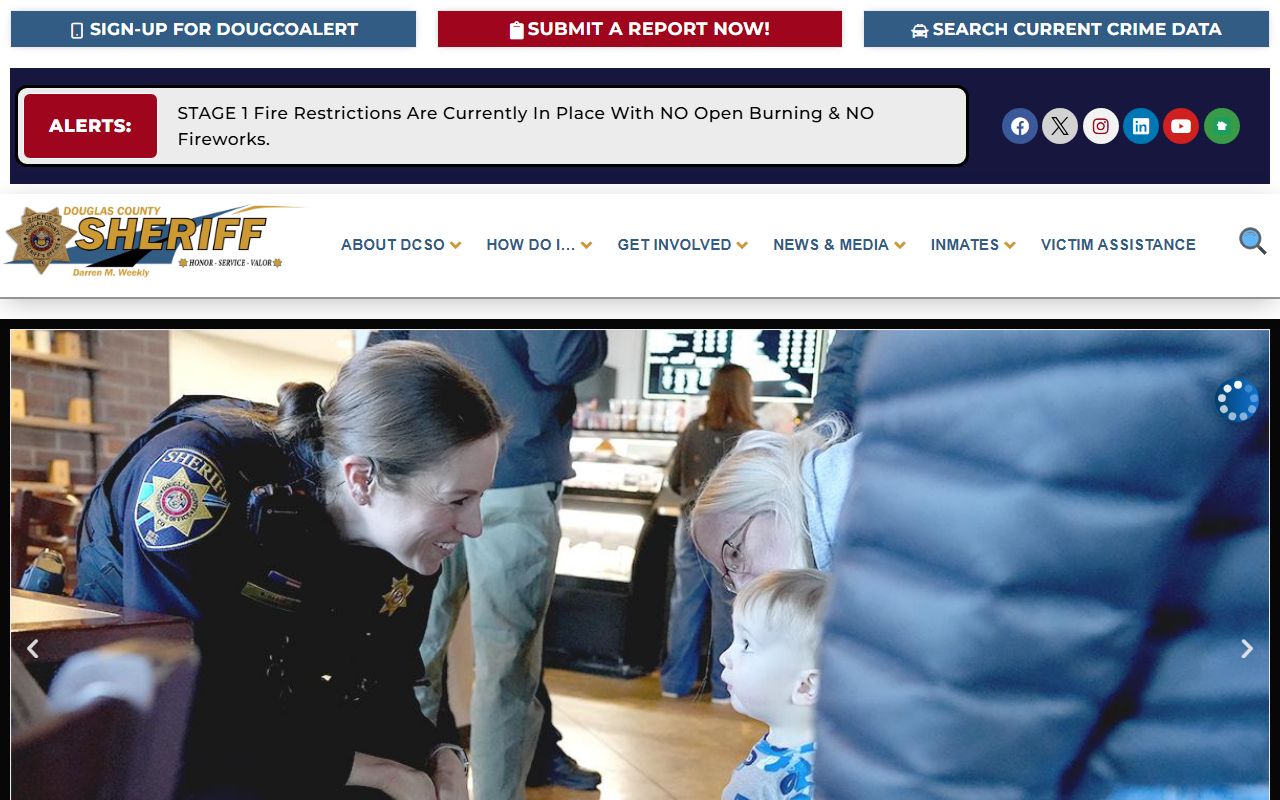
From this landing page, the records, inmates, and warrants tabs each route to the right form or portal for that record type.
Arrest Records vs Criminal Court Records
An arrest is a sheriff or police event. A court case is a court event. The two records often share a name and a date but cover different things. An arrest record starts at the jail. A court record starts when the District Attorney files a charge. Knowing which file you need will save trips and fees.
| Arrest Record | Criminal Court Record | |
|---|---|---|
| Source | Douglas County Sheriff or local police | Douglas County Combined Courts |
| Created When | Booking at the jail | Charges filed by the District Attorney |
| Contents | Booking info, charges at intake, mugshot, bond | Pleadings, motions, plea, sentence, disposition |
| Where to Request | dcsheriff.net/records | JDF 4 to the clerk at 4000 Justice Way |
| Public by Default | Yes, under CCJRA discretion | Yes, under CJD 05-01, with exceptions |
Charges vs Convictions
Being charged is not the same as being guilty. A charge is an accusation. A conviction is a finding of guilt. The bar for each is very different. Police need probable cause to arrest. The District Attorney needs probable cause to file. To convict, the state must prove the case beyond a reasonable doubt at trial or get a guilty plea on the record. People mix up these terms all the time, and that mix-up can hurt job and housing checks.
| Charge | Conviction | |
|---|---|---|
| Stage | Accusation by the DA | Verdict or guilty plea |
| Burden of Proof | Probable cause | Beyond reasonable doubt |
| Decision Maker | District Attorney filing decision | Judge, jury, or defendant on a plea |
| Public Record | Yes | Yes |
| Can Be Dropped | Yes, via dismissal or no-file | No, but may be sealed if eligible |
The court file should show the disposition for each charge. Look for terms like dismissed, deferred judgment, plea to a lesser count, acquittal, or guilty as charged. A dismissed count and a guilty count can sit side by side on the same case. Read each line.
Sealed vs Expunged Records in Colorado
Sealing and expungement are not the same. Colorado uses sealing for most adult criminal cases under Title 16. Expungement is the more limited tool and most often comes up for juvenile records under Title 19 or for a few special adult categories like underage drinking. Sealing hides the record from the public. Expungement destroys it or treats it as if it never existed.
| Sealed (Title 16) | Expunged (Title 19 and limited adult) | |
|---|---|---|
| Visibility | Hidden from public view | Destroyed or treated as never existed |
| Law Enforcement | Limited access kept for police, prosecutors, courts | Very limited; mostly used for juvenile files |
| Eligibility | Depends on offense, waiting period, disposition, and criminal history | Mostly juvenile cases and a few special adult categories |
| How to Start | File a petition with the court where the case was heard | File the right Title 19 or special petition; rules vary |
| What It Does Not Do | Force private mugshot sites to take photos down | Erase memory of an arrest from witnesses or media |
Important: A court sealing order changes what shows up in official Colorado databases. It does not force a news site or third-party mugshot site to remove a photo. Those takedowns are separate.
Mugshots and Booking Photos
Mugshots in Douglas County come from the Sheriff at intake. They get attached to the booking record. The Sheriff inmate inquiry portal may show a current mugshot for someone in custody. After release, the photo may stop showing in the live roster, but the Sheriff still keeps it in the booking file. To request a copy, use the records form on the Sheriff site under the Colorado Criminal Justice Records Act.
Private mugshot sites scrape booking photos and post them. Colorado has rules about commercial removal-fee schemes, but the basic photo can still be public if the arrest itself is public. Sealing the underlying court case is the strongest way to limit official redistribution. Private sites have their own takedown forms and rules. The Sheriff cannot force a private site to remove a photo.
Colorado Statewide Criminal Background Search
The Colorado Bureau of Investigation runs the state criminal history check. CBI is part of the Colorado Department of Public Safety and pulls fingerprint and name-based reports from the state repository. A CBI name check returns arrests reported by Colorado agencies, court dispositions when supplied, and warrant flags. CBI charges a fee per record and offers both name-based and fingerprint-based reports. Fingerprint searches are more accurate because two people can share a name and date of birth.
CBI data is the closest thing to a full Colorado snapshot, but it has limits. Out-of-state arrests do not appear unless the agency sent them in. Sealed records get hidden. Recently filed cases may not have a disposition entered yet. For a complete Douglas County background look, pair a CBI report with a Colorado Judicial Branch docket search and a Sheriff records request. For federal crimes, also check the FBI Identity History Summary process; that is a separate request handled through the FBI rather than CBI.
The 23rd Judicial District Attorney handles state criminal prosecutions for Douglas County.
View the 23rd Judicial District Attorney page for the office overview and unit list.
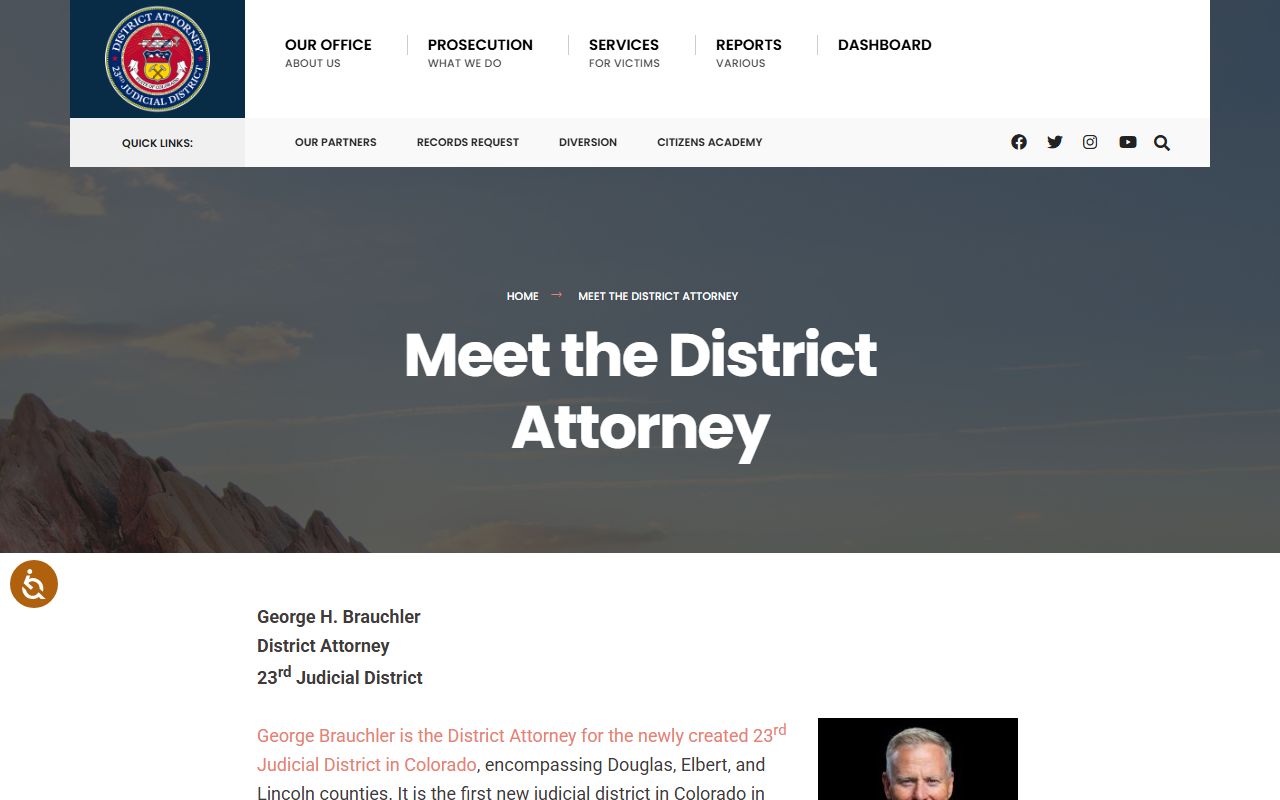
The DA homepage routes to victim services, the diversion contact, and the office contact page used for current addresses.
The 23rd Judicial District Attorney
The District Attorney for the 23rd Judicial District prosecutes state criminal cases for Douglas, Elbert, and Lincoln counties. The DA is George Brauchler. The office files charges, runs grand juries, handles plea talks, and tries cases. The DA also runs a victim services unit and may operate diversion or pre-trial intervention paths for some low-level cases. The 23rd District is a newer district, so office details can change. The official site says to confirm the address on the contact page rather than relying on older listings.
23rd Judicial District Attorney
District Attorney: George Brauchler
Counties served: Douglas, Elbert, Lincoln
Site: coda23.gov
Office address: see coda23.gov/contact for current office address and phone
Defendants who cannot afford private counsel may qualify for the Colorado State Public Defender. The state office is at coloradodefenders.us. A defendant cannot just walk in and hire the public defender. The court must appoint counsel after a financial review. Defendants should ask for the application at first appearance.
Background Check Considerations
A casual criminal lookup and an FCRA-regulated background check are not the same. A casual lookup is for personal use. It uses court dockets, sheriff records, and state repositories. An FCRA background check is for employment, tenant screening, credit, or insurance. It must follow the federal Fair Credit Reporting Act. That law sets rules on consent, dispute rights, and how old a record can be. Only a licensed consumer reporting agency can run an FCRA check.
Important: This site is not a consumer reporting agency under the FCRA. The data here may not be used for employment, tenant, credit, insurance, or any other FCRA-regulated decision.
Restricted Criminal Records in Douglas County
Not every Douglas County criminal record is open. Juvenile delinquency cases are restricted under C.R.S. Title 19. The public docket tool may not show the case at all. Access usually belongs to parties, attorneys, and authorized agencies. Sealed adult cases under C.R.S. Title 16 drop out of the public view. Sheriff incident reports for open investigations may be withheld while the case is active under C.R.S. Title 24 Criminal Justice Records Act discretion.
Other common holds include protection-order victim details, addresses for safety reasons, grand jury material, mental-health and competency exhibits, and adoption files. The court clerk and the Sheriff each apply their own rules to these categories. A denial is not always final. Some denials can be challenged under statutory procedures. A short note from your attorney or a court order can sometimes unlock parts of a file that staff cannot release on a walk-in basis.
- Sealed
- Court-ordered restriction on public access to a record. Police and prosecutors keep limited access.
- Expunged
- The record is destroyed or treated as if it never existed. Mostly used for juvenile files in Colorado.
- Disposition
- The outcome of a charge: dismissed, acquitted, guilty plea, convicted at trial, or deferred.
- Deferred judgment
- A plea is entered but judgment is held off; the case may be dismissed if the defendant finishes court terms.