
How to Search Douglas County Traffic Court Records
State traffic cases filed in Douglas County Court are searched through the Colorado Judicial Branch docket search. The same tool covers civil and criminal calendars. For traffic users it lists hearings, court date, case number, caption, and the assigned judge. The docket does not give you the full case file. To read the citation, plea sheet, deferred-judgment paperwork, or sentencing order, file JDF 4 with the court clerk at the Justice Center.
Before you start, have the citation in hand. The basics make the search faster. You will want the citation number, the case number if the court has issued one, the driver's full name, date of birth, and Colorado driver license number. Spelling matters on the name search. Common names produce multiple hits, and the clerk's counter still needs DOB or license number to confirm identity.
The portal lives on the statewide site and only shows state court files. Municipal tickets from Castle Rock, Parker, Lone Tree, or Castle Pines do not surface here. For those, contact the issuing court listed on the ticket.
Here is the basic search flow.
- Open the Colorado Judicial Branch docket search in a browser.
- Pick Douglas County from the county dropdown and pick County Court for most traffic counts.
- Enter the case number or citation number first. If you do not have one, search by the driver's last name with a date range.
- Narrow the search by courtroom or hearing date if the result list is long.
- Review the docket entry for case number, charges, hearing date, and disposition.
- If a hearing is set, note the courtroom and time. If the case is closed, note the disposition and any fine balance.
- To get a copy of the citation, plea, or order, submit a JDF 4 records request to the Douglas County Combined Courts clerk.
The first image below shows the Colorado Judicial Branch docket page that Douglas County traffic users land on. The screenshot was taken from the official statewide docket search used for Douglas County traffic court records.
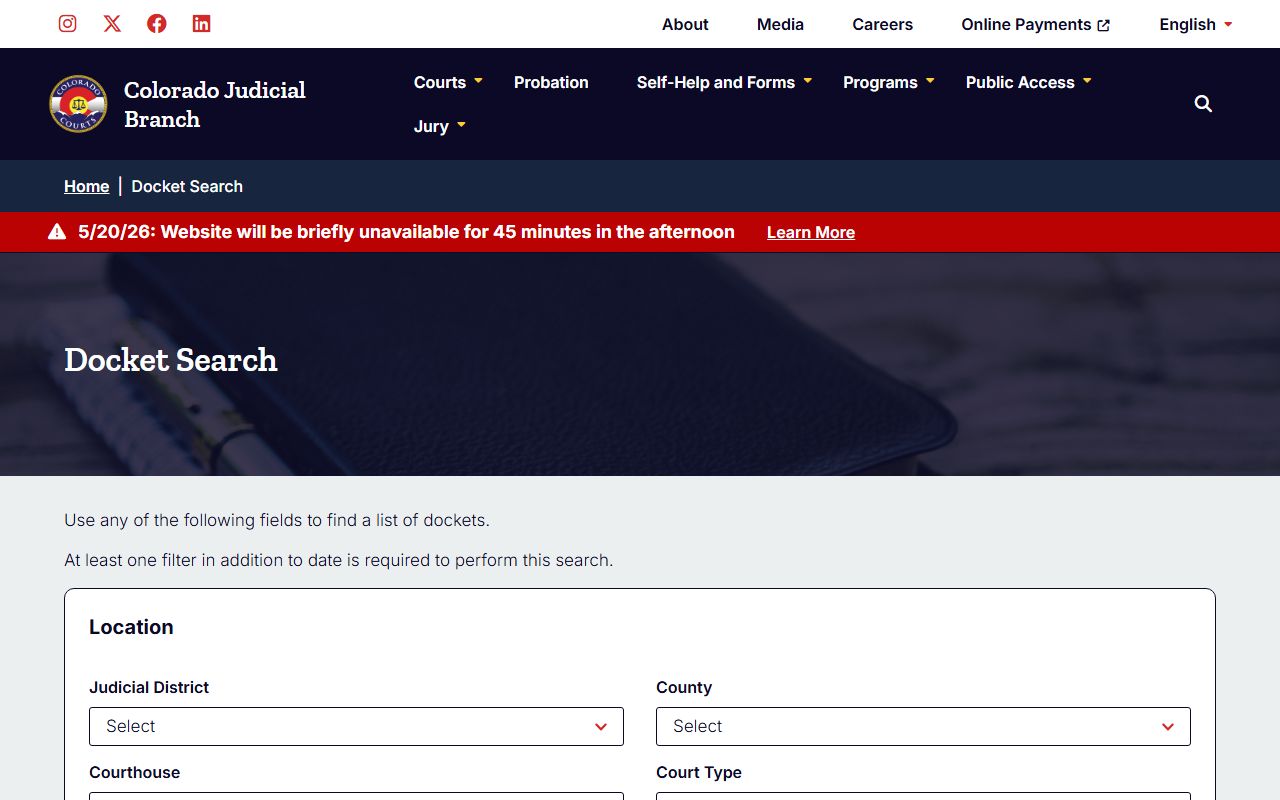
The same docket tool drives all county-level traffic searches in the state, so drivers cited in Douglas County use the same workflow as drivers cited anywhere else in Colorado.
Which Courts Handle Douglas County Traffic Cases
Traffic cases split into four buckets. State traffic charges filed by the Douglas County Sheriff, the Colorado State Patrol, or another peace officer who cited a state offense go to Douglas County Court at the Justice Center, 4000 Justice Way, Castle Rock. Municipal ordinance tickets issued in Castle Rock, Parker, Lone Tree, or Castle Pines go to that town's municipal court. Felony traffic counts such as vehicular assault, vehicular homicide, or repeat-offender DUI counts at felony level go to Douglas County District Court. Federal traffic citations on federal land or military property route to the U.S. District Court for the District of Colorado.
That split matters for the records hunt. A driver who searches the state docket and finds nothing has likely been cited by a town, not the state. The right next step is to call the municipal court named on the ticket. The Colorado Judicial Branch only publishes state county and district court files.
| Court | Traffic Cases Handled | Where to Look |
|---|---|---|
| Douglas County Court | State traffic infractions and misdemeanor traffic counts filed by the Sheriff, State Patrol, or other peace officer | Colorado Judicial Branch docket search |
| Douglas County District Court | Felony traffic counts, including vehicular assault, vehicular homicide, and felony-level DUI | Colorado Judicial Branch docket search |
| Castle Rock / Parker / Lone Tree / Castle Pines Municipal Courts | Town ordinance traffic tickets issued inside city limits | Contact the issuing municipal court named on the ticket |
| U.S. District Court for the District of Colorado | Federal traffic citations on federal property | cod.uscourts.gov |
Note: Municipal traffic dockets do not appear in the Colorado Judicial Branch docket search and must be looked up through the issuing town.
Types of Douglas County Traffic Cases on Record
The court file labels each count with the statutory citation, usually under Title 42 of the Colorado Revised Statutes (Vehicles and Traffic). The label tells the clerk and the DMV how to handle points and license action. Most state cases in Douglas County Court are routine infractions or misdemeanor moving violations, but the court also sees commercial vehicle counts, photo enforcement matters when contested, and the lower edge of DUI cases.
- Moving violations. Speeding, careless driving, failure to yield, lane use, and signal counts under Title 42.
- Non-moving violations. Equipment, registration, proof of insurance, and similar counts that do not require the vehicle to be in motion.
- Photo enforcement. Camera-generated citations that the driver elects to contest; these become court files when not paid up front.
- Commercial vehicle and CDL. Counts tied to a CDL holder or a commercial vehicle; held to stricter federal rules.
- Misdemeanor traffic. Driving under restraint, reckless driving, leaving the scene, and other counts that carry possible jail time.
- Felony traffic. Vehicular assault, vehicular homicide, and felony-level DUI; filed in District Court, not County Court.
What Douglas County Traffic Court Records Show
A docket pull shows the surface layer of the case. A full case file pulled through JDF 4 shows the paper trail behind it. The same fields show up in most state traffic files, and knowing each one helps a public user read what came back.
| Field | What It Shows |
|---|---|
| Case Number | Colorado-format case identifier assigned by the court at filing. |
| Citation Number | Officer-issued citation number from the original ticket. |
| Filing Date | Date the citation was filed with the court. |
| Court | Douglas County Court for most state traffic cases; District Court for felony traffic counts. |
| Charging Agency | Douglas County Sheriff, Colorado State Patrol, or other peace-officer agency. |
| Charges | Statutory citation under Title 42 (Vehicles and Traffic) or other Colorado statute. |
| Plea | Not guilty, guilty, no contest, or deferred-judgment plea. |
| Disposition | Conviction, dismissal, deferred judgment, deferred sentence, plea to a lesser charge, or transfer. |
| Sentence or Order | Fine, costs, surcharges, recommended license action, jail time on misdemeanor or felony counts, probation, defensive-driving requirement, or restitution. |
| Hearings | Arraignment, pretrial conference, motions, trial setting, trial, sentencing, and review. |
| Payment Status | Balance, paid in full, sent to collections, or active payment plan. |
| Driver Information | Name and identifiers from the citation; address, DOB, and license-number fields may be redacted in public docket views. |
| Restrictions and Redactions | Juvenile traffic under Title 19 may be restricted; sealed counts under Title 16 may not appear in the public docket. |
Searching by Citation Number vs by Name for Douglas County Traffic Records
The fastest pull is by citation number. The number prints on the original ticket, the summons, and any court notice. The state docket also accepts the case number once one is assigned. Name search works when the ticket is lost, but it asks for correct spelling and a narrow date range. Drivers with common names should expect more than one match and should bring date of birth or driver license number to the clerk's counter to confirm identity.
The field table below comes from the statewide docket search applied to Douglas County traffic cases. The same docket page is used for civil and criminal calendars; the notes call out what each field means for a traffic user.
| Field Label | Type | Required | Options / Format Notes |
|---|---|---|---|
| County | dropdown | yes | Select Douglas County for state traffic cases filed in Douglas County Court. Municipal traffic does not appear here. |
| Date / Date Range | date | yes | Use the court appearance date on the citation, or a window around it. |
| Court | dropdown | optional | Pick County Court for most infractions and misdemeanor traffic; District Court for felony traffic counts. |
| Division / Courtroom | dropdown | optional | Narrows by courtroom if the citation lists a division. |
| Party Name | text | optional | Driver's last name. Spelling matters; common names return multiple hits. |
| Case Number | text | optional | Colorado case number printed on the citation, summons, or court notice. |
| Citation Number | text | optional | Some traffic searches accept the officer-issued citation number; if not, fall back to case number or name. |
| Attorney / Bar Number | text | optional | Useful when defense counsel has filed an appearance. |
| Search | button | n/a | Runs the docket query. |
| Reset / Clear | button | n/a | Clears the query fields. |
If a citation does not show up in the state docket, the usual reasons are simple. The case may be in a town court instead of state court. The court may not have entered the citation yet. The case may be sealed. Or the stop may have happened in a county the driver did not expect.
Paying or Contesting a Douglas County Traffic Ticket
The Colorado Judicial Branch publishes online payment options for many traffic infractions. The citation itself lists whether the driver may pay by mail, online, or in person without a court appearance. A driver who pays gives up the right to contest the charge, accepts the conviction on the driving record, and usually accepts the points that come with it.
Drivers who want to fight a ticket must enter a not-guilty plea before the date on the ticket. Miss that date and the court can issue a bench warrant. After the not-guilty plea, the court sets a pretrial conference and, if needed, a trial. CDL holders, juveniles, drivers with prior records, and drivers whose points are close to a suspension threshold should talk to a lawyer before they pay anything. The Colorado State Public Defender at coloradodefenders.us handles indigent criminal traffic counts; the Colorado Bar Association public page lists lawyer referral options.
The seven steps below mirror the workflow the court itself uses.
- Read the citation. Confirm the court name, court address, court date, and the exact charge cited.
- Decide whether to pay and admit the charge, or contest it with a not-guilty plea.
- If paying, use the Colorado Judicial Branch online payment page, or pay by mail or in person on or before the date printed on the ticket. Save the receipt.
- If contesting, file the not-guilty plea on time. Failure to appear can trigger a bench warrant.
- Prepare for the pretrial conference. Review the evidence, request discovery, and weigh deferred-judgment options if you are eligible.
- Attend the trial, or accept a plea to a reduced charge if the prosecutor offers one and you agree.
- After disposition, confirm the court reported the outcome to DMV and that the driving record matches the court file. Errors get fixed at the court and DMV, not at any third-party site.
Public Access Laws for Douglas County Traffic Court Records
Court traffic files in Colorado are governed by a mix of court rules and statutes. Chief Justice Directive 05-01 controls public access to Colorado court files, including County Court traffic dockets. The Colorado Open Records Act at C.R.S. Section 24-72-201 et seq. covers county administrative records but generally does not govern court files. The Colorado Criminal Justice Records Act at C.R.S. Section 24-72-301 et seq. governs traffic-related law-enforcement records held by the Douglas County Sheriff or another peace-officer agency, including incident reports, body-camera media when released, and crash investigation files.
Juvenile traffic counts are restricted under Title 19. Sealed counts are restricted under Title 16. DMV driver-record privacy is set by Colorado statute and by the federal Driver's Privacy Protection Act, 18 U.S.C. Section 2721 et seq., which limits who may request a driver record and for what purpose.
Key Authorities:
Chief Justice Directive 05-01 sets the public-access framework for Colorado court files, including County Court traffic dockets.
C.R.S. Section 24-72-301 et seq. (Criminal Justice Records Act) governs traffic-related law-enforcement records held by the Sheriff or other peace-officer agency.
C.R.S. Title 16 sealing rules govern when an adult traffic count can be sealed from public view.
Court Traffic Records vs State Driver Records
The court traffic record and the state driver record are two different files. The court file sits with the court that handled the case. The driver record sits with the Colorado DMV. A dismissal in court produces a court file but should not add points to the driver record. A conviction in court is reported to DMV and then shows up in the driver record. Drivers who only pull one file are seeing half the picture. CDL drivers, drivers with prior counts, and drivers facing employment or insurance review usually need both.
The comparison below lays out the differences side by side.
| Topic | Court Traffic Record | State Driver Record |
|---|---|---|
| Source | Court that handled the case (Douglas County Court, District Court, or a municipal court) | Colorado Division of Motor Vehicles |
| What it shows | Citation, charges, plea, hearings, disposition, sentence, court fines, deferred-judgment paperwork | Points history, convictions reported by courts, license sanctions, restraints, suspensions, revocations, and reinstatements |
| Where to access | Colorado Judicial Branch docket search, a JDF 4 request, or the municipal court for ordinance cases | Colorado DMV driver-record request process at dmv.colorado.gov |
| How to correct an error | Motion or written correspondence with the court that handled the case | DMV correction process tied to the underlying court action |
| Who may request | Public under CJD 05-01 unless sealed or restricted; a party may always request | Restricted by Colorado law and the federal DPPA; the driver may always pull their own record |
The image below is the Colorado Judicial Branch filing-fee page from the state court fee schedule. It is the live source for what the court charges to pull or certify a Douglas County traffic record copy.
The DMV fee for a driver record is set separately by the state DMV and is not on that court page.
CDL and Commercial Driver Records
Commercial driver license holders are held to a stricter standard. Federal rules adopted by Colorado mean CDL holders convicted of certain counts in any vehicle face longer disqualifications, sometimes for life on a second serious offense. A CDL driver who pleads to a non-CDL disposition still sees the underlying conviction reported to DMV and to the federal Commercial Driver's License Information System. Defensive-driving alternatives that help a regular driver may not help a CDL holder at all.
Out-of-state convictions still reach the Colorado record. The Driver License Compact and CDLIS share conviction data across states, so a ticket picked up on a long-haul run shows up at home. CDL drivers facing a Douglas County citation should talk to counsel before paying any ticket, even a small one.
DUI and DWAI Cases
DUI and DWAI counts are state criminal charges, not pure traffic infractions. Misdemeanor DUI counts get filed in Douglas County Court. Felony DUI counts (usually four or more lifetime DUI convictions, or DUI cases that meet vehicular assault or vehicular homicide elements) get filed in Douglas County District Court. Every DUI case runs on two tracks at the same time: the court track for the charge, plea, and sentence, and the DMV Express Consent track for license revocation.
For full Douglas County DUI and DWAI case information, see Douglas County criminal records. Drivers worried about a missed appearance should also check Douglas County warrant records.
Deferred Judgment and Defensive Driving
Colorado does not use the phrase "deferred adjudication." The closest tools are the deferred judgment and sentence under Title 18 for criminal counts, and the deferred judgment available for some traffic counts in County Court. In a deferred judgment the driver pleads guilty, the court delays entry of judgment for a probation period, and if the driver finishes the conditions (no new offenses, classes, fees), the court dismisses the case.
A dismissed deferred case usually does not add points to the driving record, but the court file stays in place unless it is later sealed. Defensive-driving courses approved by the state may reduce points on the driver record for eligible drivers. Eligibility, course providers, and the point reduction itself are administered by DMV, not by the court. Both tools can be limited or unavailable for CDL holders, repeat offenders, juveniles, or specific charge types.
Note: A deferred case can still appear in a background check until it is sealed under Title 16.
Sealing or Expunging Douglas County Traffic Records
Colorado sealing law in Title 16 covers most adult criminal records, and that includes some misdemeanor traffic counts. Eligibility ties to the charge, the disposition, the waiting period, payment of fines and restitution, and the absence of disqualifying later convictions. Sealing a court file restricts public access at the court and at the agencies notified by the sealing order. It does not erase the conviction from every database, and it does not by itself wipe the entry from the DMV driver record.
Juvenile traffic counts are handled under Title 19 confidentiality rules and are not the same as adult sealing. A driver who wants to clear a record should review the Colorado Judicial Branch self-help instructions, pick the right petition or motion, file in the court that handled the case, serve the prosecutor and any required agency, and attend any hearing the court schedules. Help is available through Colorado Legal Services for income-eligible petitioners.
Fees for Douglas County Traffic Record Copies
Court copy fees are set by the Colorado Judicial Branch fee schedule and apply uniformly across counties. The live amounts and any recent updates are listed on the state filing-fee page; the table below points to that source so users see the current dollar amount instead of a stale number.
| Item | Amount / Status | Source |
|---|---|---|
| Plain copy of a court traffic file | Per-page charge set by the state fee schedule | Colorado Judicial Branch filing-fee page |
| Certified copy of a court traffic file | Higher than plain copy; certification fee plus per-page | Colorado Judicial Branch fee schedule |
| Document search by clerk | Search fee may apply if staff time is required | Colorado Judicial Branch fee schedule |
| JDF 4 record request | No charge for the request form; copy and certification fees apply when fulfilled | JDF 4 request page |
| Colorado DMV driver record | DMV fee applies; check the current rate before requesting | dmv.colorado.gov |
| Municipal court copies | Set by each town's municipal court | Issuing municipal court named on the ticket |
Fee waivers for indigent litigants use JDF 205, the state motion to file without payment, and a supporting financial affidavit. The court rules on the waiver and the order applies to court fees, not to DMV fees.