
How to Search Douglas County Court Records
Court records for Douglas County are kept by the Colorado Judicial Branch, not by a county-run portal. The main public tool is the Colorado Judicial Branch docket search. A docket shows the date, time, courtroom, hearing type, case caption, and case number for scheduled court events. To pull copies of pleadings, orders, or a full case file, the court clerk uses the record and document request page and the JDF 4 form. The Douglas County Combined Courts page ties all of this together in one place.
Before starting, know the case type. Felonies, divorce, juvenile, probate, and larger civil matters live in District Court. Misdemeanors, traffic, small claims, and county civil matters live in County Court. Marriage licenses and recorded land documents sit at the Douglas County Clerk and Recorder, not the court clerk. Sheriff incident reports and inmate data come from the Douglas County Sheriff. A case number, ticket, summons, or notice to appear speeds the search a lot.
The state docket portal is best for hearing dates. The record request form is best for full case files and certified copies. Both are free to use, though copy fees apply when paper or certified records are produced.
The lead-in screenshot below opens directly on the Combined Courts page. It is the first stop for new users. The state Judicial Branch listing for Douglas County Combined Courts shows the address, phone, division links, and links to dockets, jury, and forms.
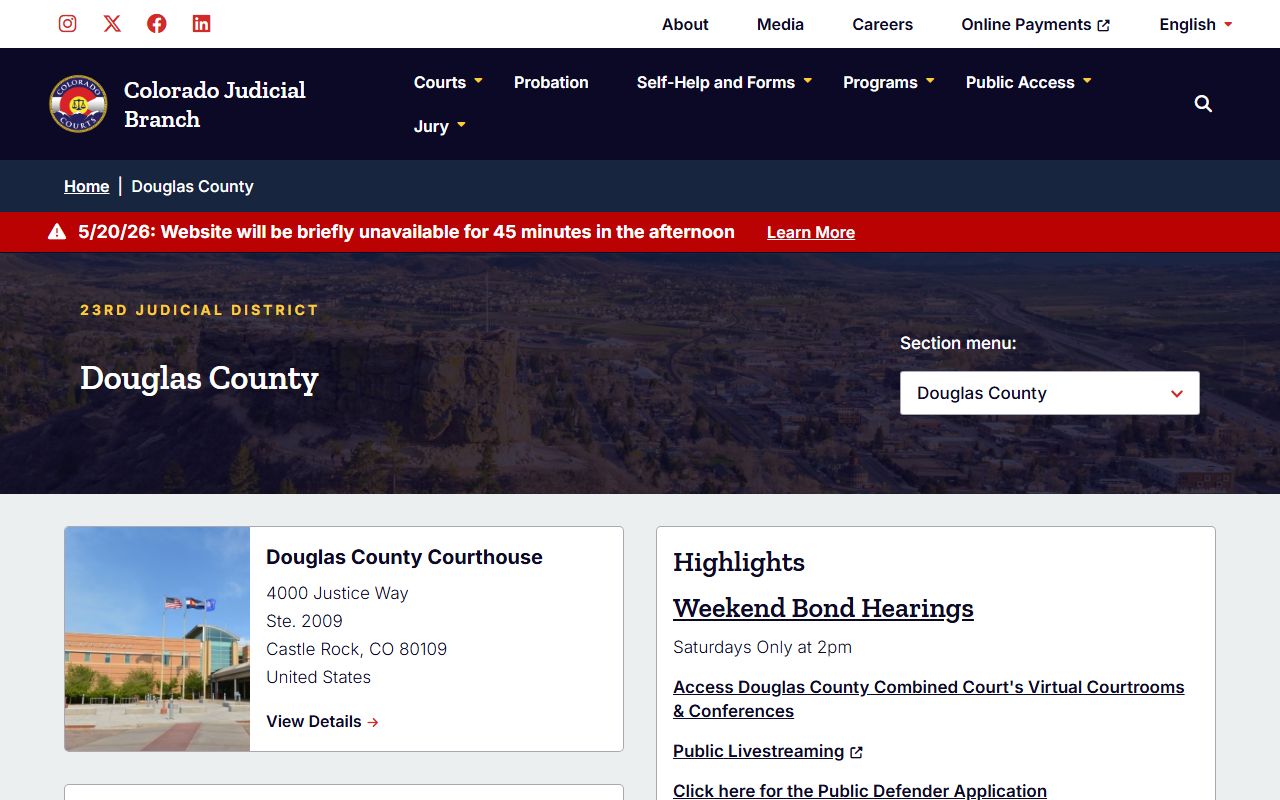
That page is the launch pad for almost every Douglas County court records task. From there, the docket search, forms library, and record request form are one click away.
- Open the Colorado dockets page and select Douglas County from the county dropdown.
- Pick a date or short date range. Add a party name or case number if known.
- Choose District Court or County Court if the form exposes a court filter.
- Run the search and review the hearing list. Note the case number for any matching entry.
- If the docket is not enough, complete JDF 4 and send it to the Combined Courts clerk for copies or certified records.
- Pay the clerk fee for plain or certified copies. Pick up, mail, or email is set on the form.
For sealed, juvenile, adoption, or mental health files, the docket may show nothing. The clerk can confirm only what the rules and court order allow. A court order is often needed before a sealed file gets released.
Note: Confirm any case number from a ticket, summons, or court notice before paying for copies, since one wrong digit returns no file.
The Douglas County Judicial System
Colorado runs a unified, state-administered court system. The top court is the Colorado Supreme Court. Below it is the Colorado Court of Appeals, the state's intermediate appellate court. Trial work falls to District Courts and County Courts. Municipal courts created by cities and towns handle ordinance cases on the side. Douglas County users may also touch the U.S. District Court for the District of Colorado for federal claims.
Douglas County is part of the 23rd Judicial District. That district covers Douglas, Elbert, and Lincoln counties. It split from the older 18th Judicial District, which had grown too large. The change reshaped judge assignments, court administration, probation, and the District Attorney's footprint. Cases move through the same Combined Courts building on Justice Way, but the district label is new.
Case flow: County Court or Municipal Court › District Court › Colorado Court of Appeals › Colorado Supreme Court
The statewide docket page covers both District and County Court hearings in Douglas County. A screenshot of that interface is below.
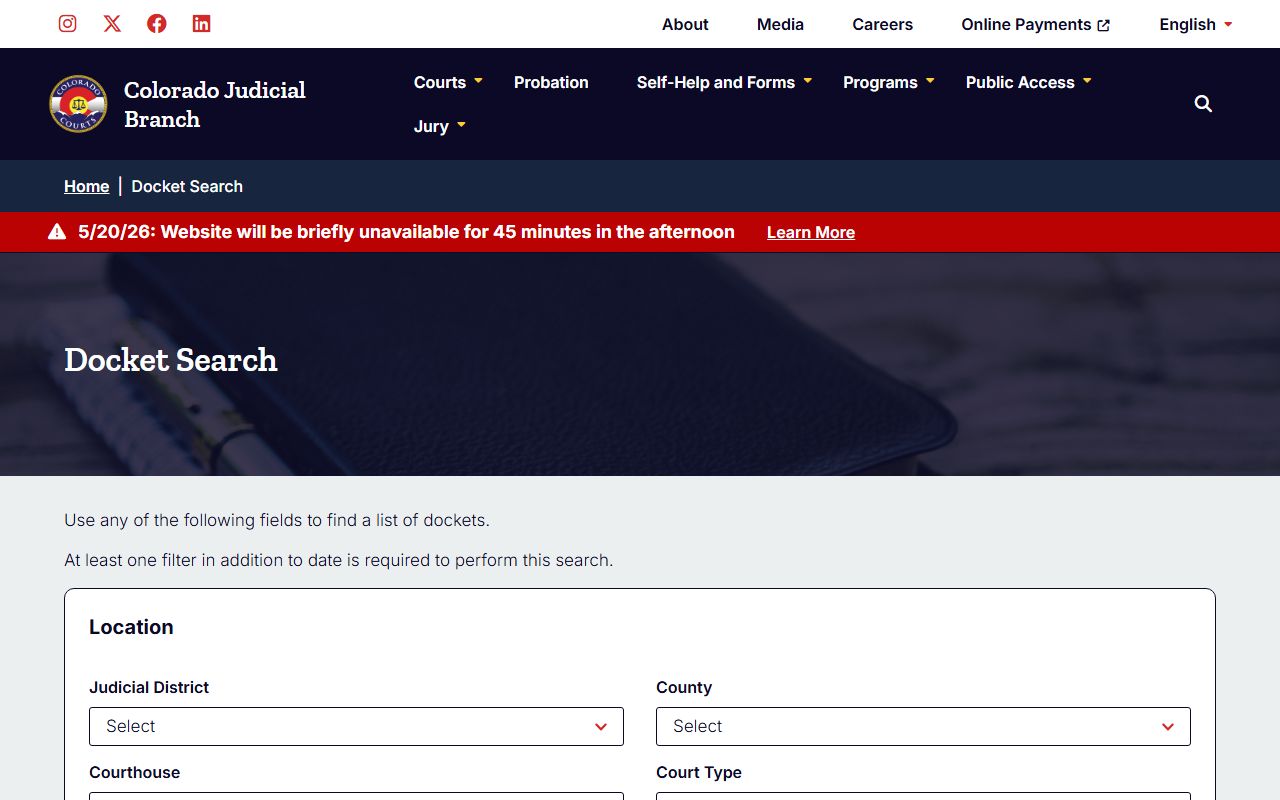
The docket tool is the same form used for every Colorado county. Pick Douglas, set a date, and run the search to see all scheduled cases.
| Court | Jurisdiction | Case Types |
|---|---|---|
| Douglas County District Court | General jurisdiction trial court | Felonies, civil over the county limit, divorce, juvenile, probate, mental health |
| Douglas County Court | Limited jurisdiction trial court | Misdemeanors, traffic, small claims, county civil, protection orders, preliminary hearings |
| Castle Rock / Parker / Lone Tree Municipal Court | City ordinance jurisdiction | Municipal traffic, code violations, local ordinance offenses |
| Colorado Court of Appeals | Intermediate appellate | Appeals from District Court and most County Court matters |
| Colorado Supreme Court | State court of last resort | Direct review and discretionary appeals |
Douglas County Courthouses and Offices
The Douglas County Justice Center is the one main court building for the county. The state Combined Courts, the District Attorney, the Sheriff, and the county jail all sit on or near the same campus on Justice Way in Castle Rock. The Clerk and Recorder is a separate county office at a separate address downtown. Knowing which building to walk into saves time, since court files, recorded land documents, and marriage licenses live in different places.
The 23rd Judicial District Attorney office handles state prosecution for Douglas, Elbert, and Lincoln counties. The DA office is led by District Attorney George Brauchler. The full DA homepage screenshot is below.
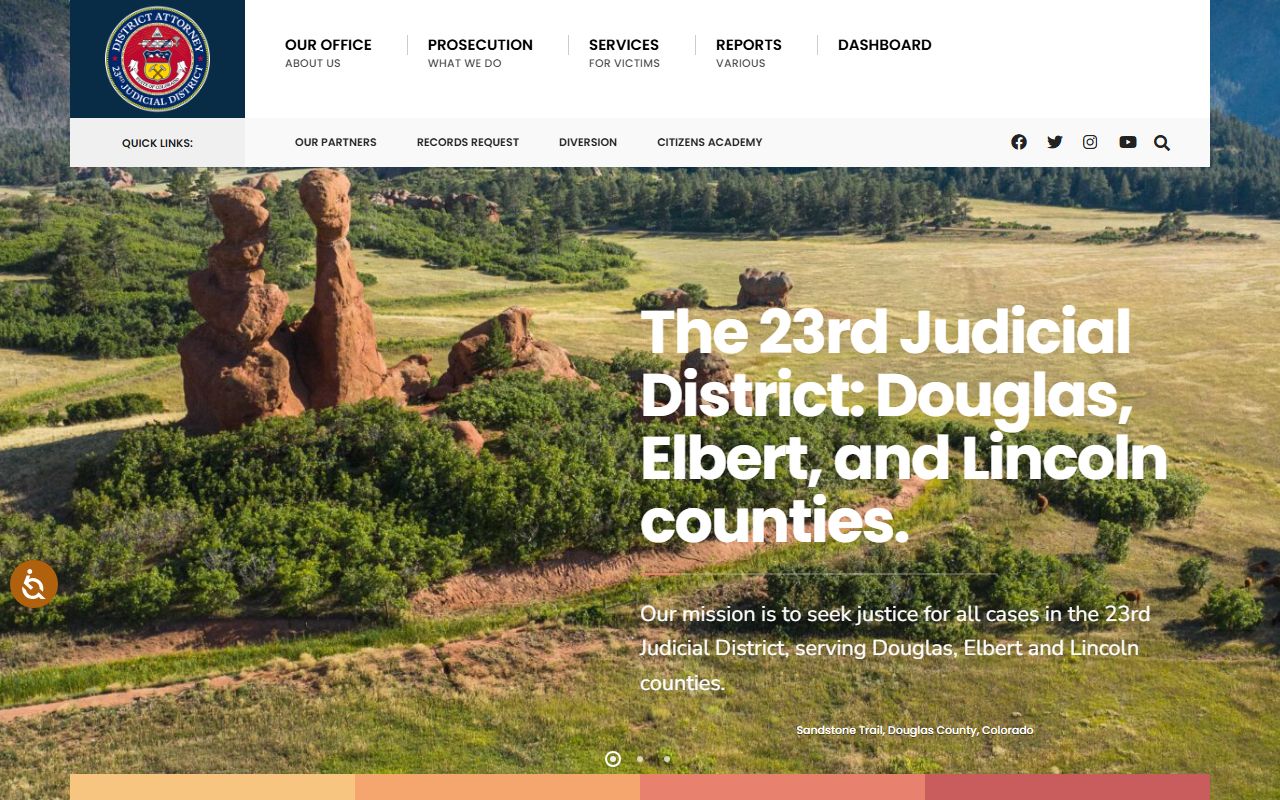
The DA site lists contact details, victim services, and unit pages. Defense referrals for those who cannot afford a lawyer go to the Colorado State Public Defender through the court.
Douglas County Justice Center
4000 Justice Way
Castle Rock, CO 80109
720-437-6200
Douglas County Clerk and Recorder
301 Wilcox Street
Castle Rock, CO 80104
See Clerk site for current numbers
Douglas County Sheriff
4000 Justice Way
Castle Rock, CO 80109
See Sheriff site for current numbers
Types of Court Records Available in Douglas County
The Combined Courts hold the full range of state-court files. Each case class has its own rules for what is public, what is sealed, and what lives in another office. The state Judicial Branch keeps the case files; the Sheriff keeps booking and incident records; the Clerk and Recorder keeps recorded land documents and marriage licenses. A short tour helps users send the right request to the right office on the first try.
Some files cross more than one office. A divorce decree is a court file but the underlying marriage license is a Clerk and Recorder record. A criminal case has a court file at the Combined Courts and an arrest report at the Sheriff. A probate case lives in District Court but the deeds it touches sit on LandmarkWeb at the Clerk and Recorder. The links below cover the main paths.
- Criminal records - Felony files in District Court, misdemeanors in County Court, arrests at the Sheriff.
- Civil records - Complaints, answers, judgments, garnishments, and writs from District and County Court.
- Family and divorce records - Dissolution, parenting plans, support orders, and decrees in District Court.
- Probate records - Estates, wills, guardianships, and conservatorships in District Court.
- Traffic records - Tickets and traffic misdemeanors in County Court; municipal tickets in city court.
- Warrant records - Bench warrants from the court; arrest warrants through the Sheriff.
- Inmate records - Current jail roster and booking data from the Sheriff inmate portal.
Juvenile delinquency, dependency and neglect, and adoption files are restricted. Public search will often return nothing for these case classes. That is by design under Title 19 of the Colorado Revised Statutes.
What Douglas County Court Records Show
A typical Douglas County court record lists the case number, the court location, the case caption, the filing date, the case type, and the current status. It also shows the parties, any attorneys, the assigned judge or magistrate, the docket entries, and the hearing schedule. The case number itself carries clues. Colorado case numbers blend the filing year, a case class code such as CR, CV, DR, JV, PR, M, T, or S, and a sequence number. A docket pulls the surface data. The full case file pulls the documents.
Some fields are always redacted. Social Security numbers, account numbers, dates of birth, minor names, victim addresses, and medical details are kept out of the public view. The clerk applies these redactions under court rules and Chief Justice Directive 05-01. Sealed cases drop out of the public list entirely. The table below maps the most common fields a user sees on a Douglas County court record.
| Field | What It Shows |
|---|---|
| Case Number | Year, case class code, and sequence number for the Douglas County filing |
| Filing Date | Date the first pleading or charging document hit the court |
| Parties | Plaintiff, defendant, petitioner, respondent, or estate name |
| Charges or Cause | Criminal counts, civil claims, or family relief sought |
| Disposition | Outcome: guilty, not guilty, dismissed, judgment, decree, or settled |
| Sentence or Judgment | Jail, probation, fines, money judgment, or court order |
| Hearings | Date, time, courtroom, hearing type, and judge or magistrate |
| Documents | Pleadings, orders, decrees, and notices, where public |
Public Access Laws for Douglas County Court Records
Colorado splits public records into three lanes. County government records fall under the Colorado Open Records Act. Sheriff and other law enforcement records fall under the Colorado Criminal Justice Records Act. Court case files fall under the rules of the Colorado Judicial Branch, most of all Chief Justice Directive 05-01. A user who wants a sheriff report, a county budget, and a court file for one event may need to send three different requests. The official statute text is at the Colorado Revised Statutes site.
The Sheriff handles the criminal justice records lane through the records request page. The county handles CORA requests through the Douglas County open records page. Court files use JDF 4 and the state clerk. Each lane has its own response window, fee schedule, and review process.
Key Statutes:
Colorado Revised Statutes § 24-72-201 et seq. - The Colorado Open Records Act, which gives broad public access to state and local government records.
Colorado Revised Statutes § 24-72-301 et seq. - The Colorado Criminal Justice Records Act, which governs Sheriff and police records and allows more agency discretion.
Colorado Revised Statutes § 24-72-204 - Lists records that may or must be withheld, supporting redaction of part of a file.
Chief Justice Directive 05-01 - The core access rule for court case files in Colorado, including Douglas County District and County Court.
Colorado Revised Statutes Title 19 - Sets confidentiality for juvenile delinquency, dependency, and child welfare case records.
Federal overlays also apply. HIPAA can shield medical exhibits in court or jail files. FERPA can shield school records filed in juvenile or family cases. These are not state laws, but they explain why some exhibits are blacked out before release.
Records That Are Restricted or Confidential
Not every Douglas County court file is open. Juvenile delinquency, dependency and neglect, adoption, mental health commitments, and grand jury matters are kept out of public view by default. Sealed criminal cases drop off public search after a sealing order. Expunged records, used for limited statutory categories, are treated even more strictly. The court will not show these files at the public counter, and the docket will not list them online.
Petitioning to view a sealed file is not a quick task. A person without statutory access has to file a motion in the court that handled the case, serve the District Attorney and any affected agencies, and wait for a hearing. The judge weighs privacy, public interest, victim impact, and the reason for the request. Sealed records can still flow to police, prosecutors, and licensing boards under statutory carve-outs, even when the public view stays closed.
Protection order files redact the protected party's address and phone. Domestic relations files hold back financial details and child-related reports. Even open civil cases black out account numbers and dates of birth before release.
Specialty Courts in Douglas County
The Colorado Judicial Branch supports problem-solving courts statewide. These dockets focus on treatment instead of straight punishment for cases that fit narrow eligibility rules. Common Colorado examples include adult drug court, DUI court, veterans treatment court, mental health court, family treatment court, and juvenile treatment court. Local availability shifts as judges, funding, and program staff change. The 23rd Judicial District and the state Judicial Branch keep the active program list.
Eligibility usually turns on the charge, the criminal history, a substance use or mental health assessment, the prosecutor's position, and the victim's position. Participants attend frequent court reviews, treatment sessions, testing, and case management for 12 to 24 months in most programs. A successful graduate may get a deferred sentence, dismissal, reduced jail time, or a lighter probation outcome. The court, the District Attorney, defense counsel, probation, and treatment staff all sign off before a referral lands.
Cases that do not fit a specialty court still move through the regular District or County Court calendar. Defense attorneys and the public defender's office are the right starting point to ask about a treatment track.
Douglas County Sheriff and Jail
The Douglas County Sheriff's Office runs the county jail at the Justice Center campus. Sheriff Darren Weekly leads the office. The Sheriff homepage links out to inmate information, bonds, mail, money, visitation, warrants, and records request pages. The Sheriff keeps booking, custody, arrest, and incident records, which are separate from the court case file. A user who needs both a court record and an arrest report has to send two requests to two offices.
The Sheriff inmate page is the launching point for the current jail roster. A public inmate inquiry portal is linked from that page. The screenshot below is the Sheriff inmate landing page.
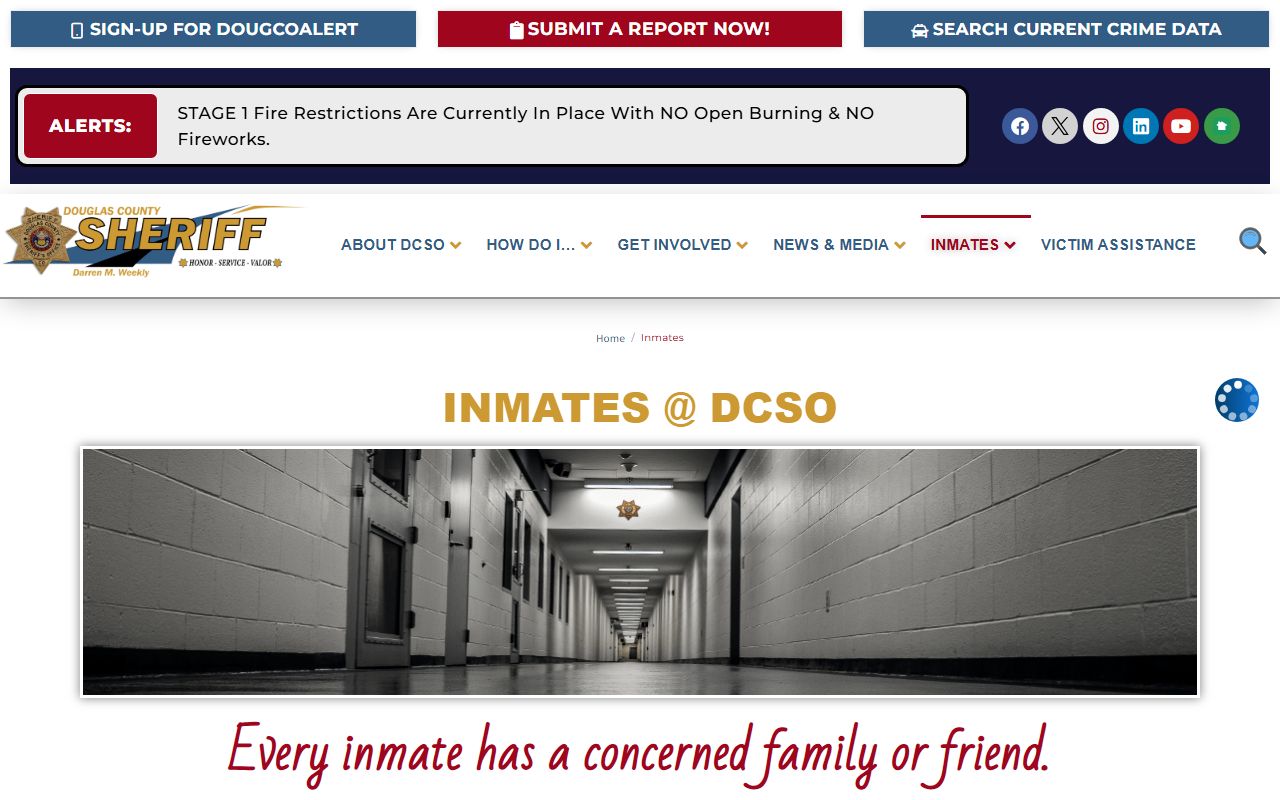
From that page, users move to the inmate inquiry portal, the visitation page, the mail page, the money deposit page, and the bonds page. For active warrants, the Sheriff warrants page is the official local source.
The screenshot below shows that warrants page directly. There is no fully searchable public active warrant database in Douglas County, so the page lists how to confirm a warrant and what to do next.
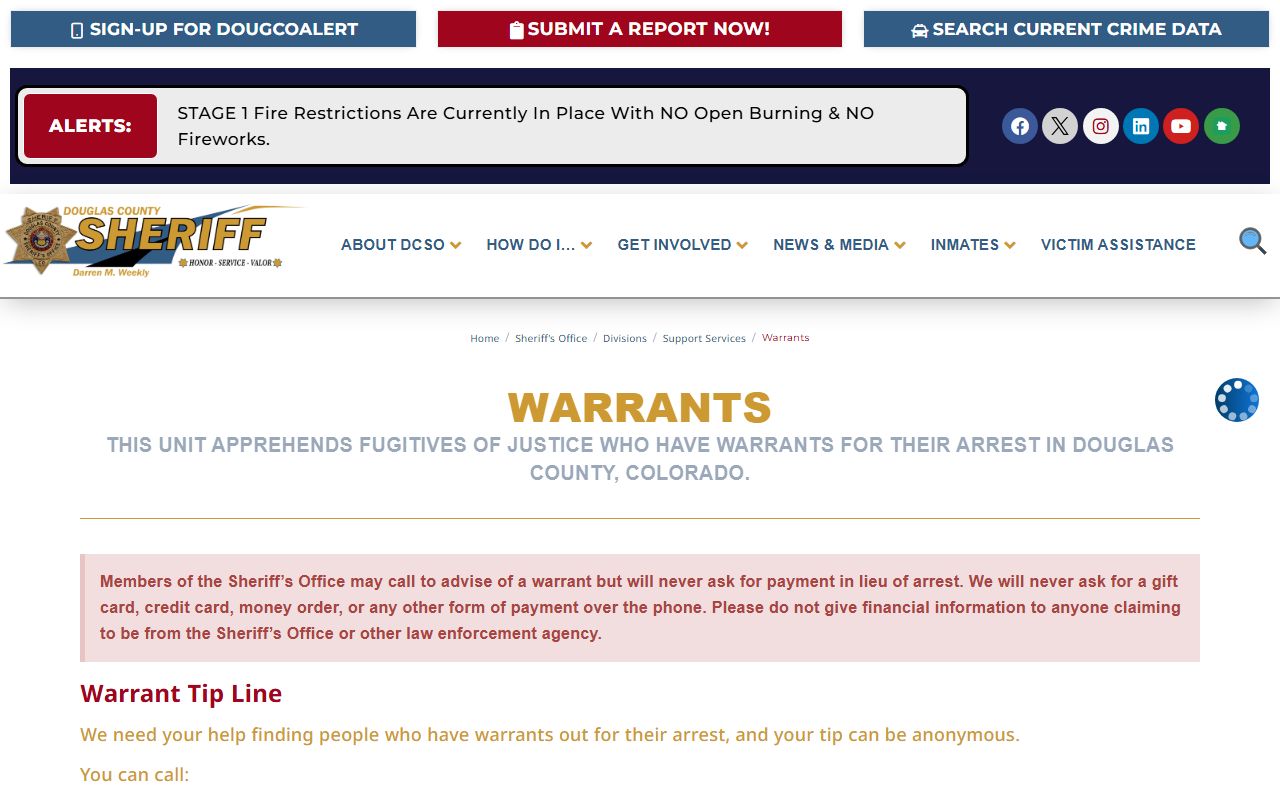
For the full jail roster and booking details, see Douglas County inmate records. For active warrant lookup steps, see warrant records. For data on the jail population and demographic snapshots, see jail population, and for recent release verification, see released inmates.
Note: Posting bond does not always trigger immediate release if a hold, warrant, or court condition is still in place.
Marriage, Divorce, and Probate Records
Marriage licenses in Douglas County come from the Douglas County Clerk and Recorder, not the court. The county marriage license page lists the current fee, ID rules, age limits, and appointment process. Colorado allows ceremonial marriage, common-law marriage, and self-solemnization under the right conditions. The county does not require a blood test. After the ceremony, the signed license is returned to the Clerk and Recorder for recording, and certified copies come from that office. The full county Clerk and Recorder homepage is shown below.
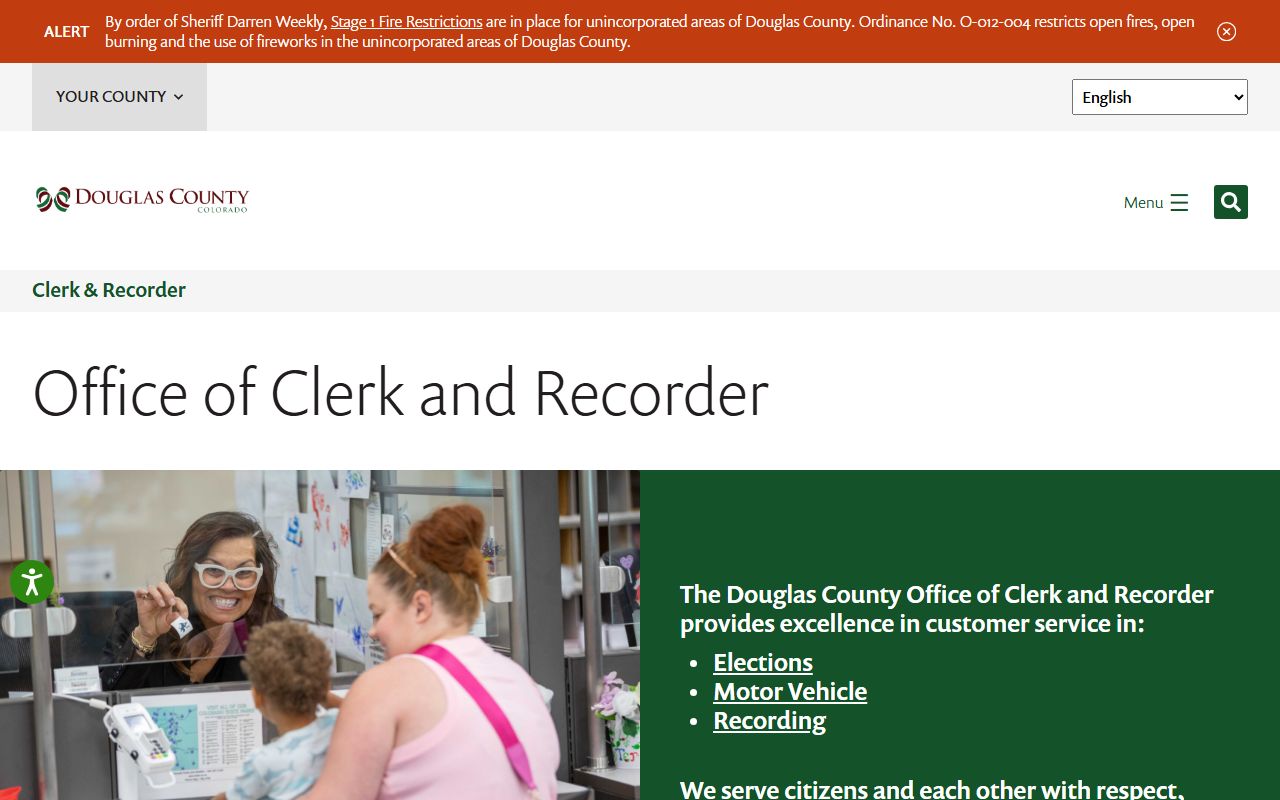
The Clerk and Recorder also runs LandmarkWeb, the county portal for recorded deeds, deeds of trust, plats, releases, and liens. For full details on marriage license steps, divorce filing, and certified decree copies, see Douglas County marriage and divorce records. Probate cases land in District Court at the Combined Courts; full coverage lives on the probate records page.
- Testator
- A person who makes a will, naming who gets property at death.
- Executor
- The person named in a will to carry out its terms; also called personal representative in Colorado.
- Intestate
- Dying without a valid will; state law sets who inherits.
- Conservator
- A person appointed by the court to manage the finances of a protected adult or minor.
- Guardian
- A person appointed by the court to make personal and care decisions for a minor or incapacitated adult.
Douglas County Court Records Fees
Copy fees at the Combined Courts follow the Colorado Judicial Branch fee schedule. Plain copies, certified copies, certification stamps, records searches, and exemplified copies each carry their own cost. The clerk sets the final total based on copy type, page count, and any search staff time. The state filing fees and surcharges page covers filing fees by case class. Users who cannot pay can ask for a fee waiver through JDF 205.
The state record and document request page, shown in the screenshot below, links to the full JDF 4 form. JDF 4 collects the case number, copy type, delivery method, and signature.
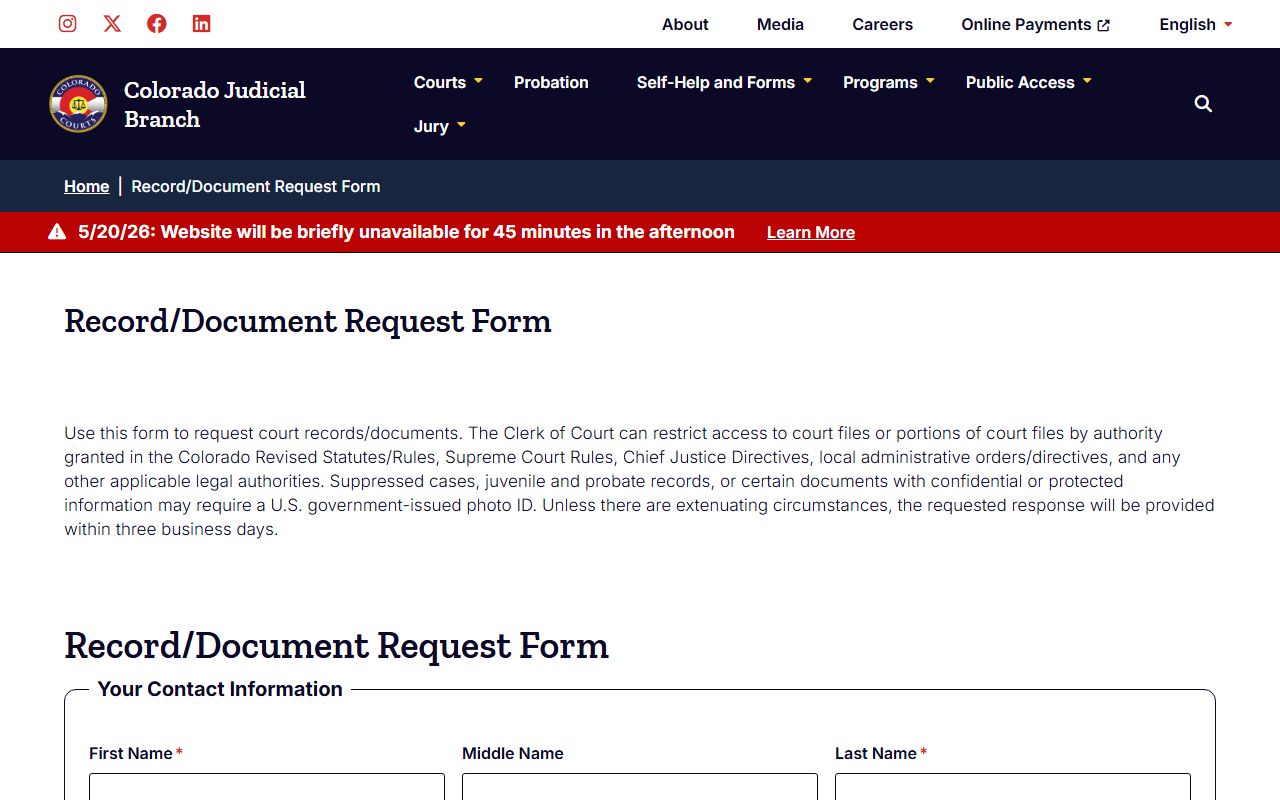
Submitting JDF 4 to the Combined Courts clerk starts the copy process. The clerk replies with the total fee due before pulling the file. Plain copies are usually cheaper than certified copies. Certified copies are needed for out-of-state filings, immigration, name change proof, and most licensing applications.
| Item | Source |
|---|---|
| Plain copy per page | Set by the state Judicial Branch fee schedule; confirm at the Combined Courts clerk |
| Certified copy per page | State fee schedule; certified copies cost more than plain copies |
| Certification fee | Separate stamp fee added to certified copies; confirm with clerk |
| Records search fee | May apply for staff search time; confirm before requesting |
| Filing fee waiver | JDF 205 motion if the requester cannot pay |
| Marriage license | Set by the Douglas County Clerk and Recorder; confirm on the county marriage page |
Note: Fee amounts shift over time; check the state filing fee page or the clerk before sending payment.
How to Interpret Douglas County Court Records
Court records use a lot of short codes. A case number like 2024CR12345 means a 2024 criminal filing. CV is a civil case. DR is domestic relations. JV is juvenile. PR is probate. M is a misdemeanor. T is traffic. S is small claims. Docket entries use short tags too: MOT for motion, ORD for order, JDG for judgment, CONT for continuance, FTA for failure to appear, and DISP for disposition. Knowing these tags cuts the time to read a long docket in half.
The most-asked question on a criminal record is the gap between a charge and a conviction. A charge is the accusation. A conviction is a guilty plea or a guilty verdict that the court enters as the disposition. A dismissed charge, an acquittal, or a deferred sentence that finishes clean is not a conviction. That distinction matters for background checks, jobs, housing, and licensing. The full case docket shows the path from charge to outcome, not just the final code.
Sentencing language can also confuse new readers. A suspended sentence, a deferred judgment, probation, work release, and a county jail term are all different outcomes with different rules. When in doubt, the docket and the sentencing order spell it out.
Accuracy and Record Limitations
Court records update on a clerk's schedule. A filing made today may not appear on the public docket for a day or two. A sealing order, an expungement, or a case transfer can pull a file out of the public view without notice. The Sheriff's inmate portal refreshes on its own cycle and may show a person who has already been released, or hide a person who was just booked. A docket hit is a strong lead, not a final word.
Errors do happen. A misspelled name, a wrong birth date, a missing charge, or a stale disposition can all sit on a record until someone flags it. The fix starts with the clerk for court records or the Sheriff for jail and arrest records. A court order is sometimes needed to correct a final entry. For a sealing, expungement, or correction, an attorney is usually a smart call.
Note: Always confirm a court record with the Douglas County Combined Courts clerk before relying on it for legal, employment, or financial decisions.
History of Douglas County Courts
Douglas County was created in 1861 as one of Colorado's original counties. Castle Rock has been the county seat from the start. The county's court history runs from a small territorial courthouse to a campus-style Justice Center on Justice Way. Growth along the I-25 corridor between Denver and Colorado Springs pushed filings up across every case class. The current Combined Courts location on Justice Way reflects that scale.
The most recent big change is the creation of the 23rd Judicial District. Douglas, Elbert, and Lincoln counties moved out of the old 18th Judicial District, which had grown too large to manage as one unit. New district numbers mean new docket headers, new DA letterhead, and a new probation structure, but the underlying court building and the underlying state court rules stay the same.
For local history context, the county historic preservation page covers Castle Rock and the broader county. For the federal layer over Douglas County, the U.S. District Court for the District of Colorado handles federal claims. A screenshot of that federal court homepage is below.
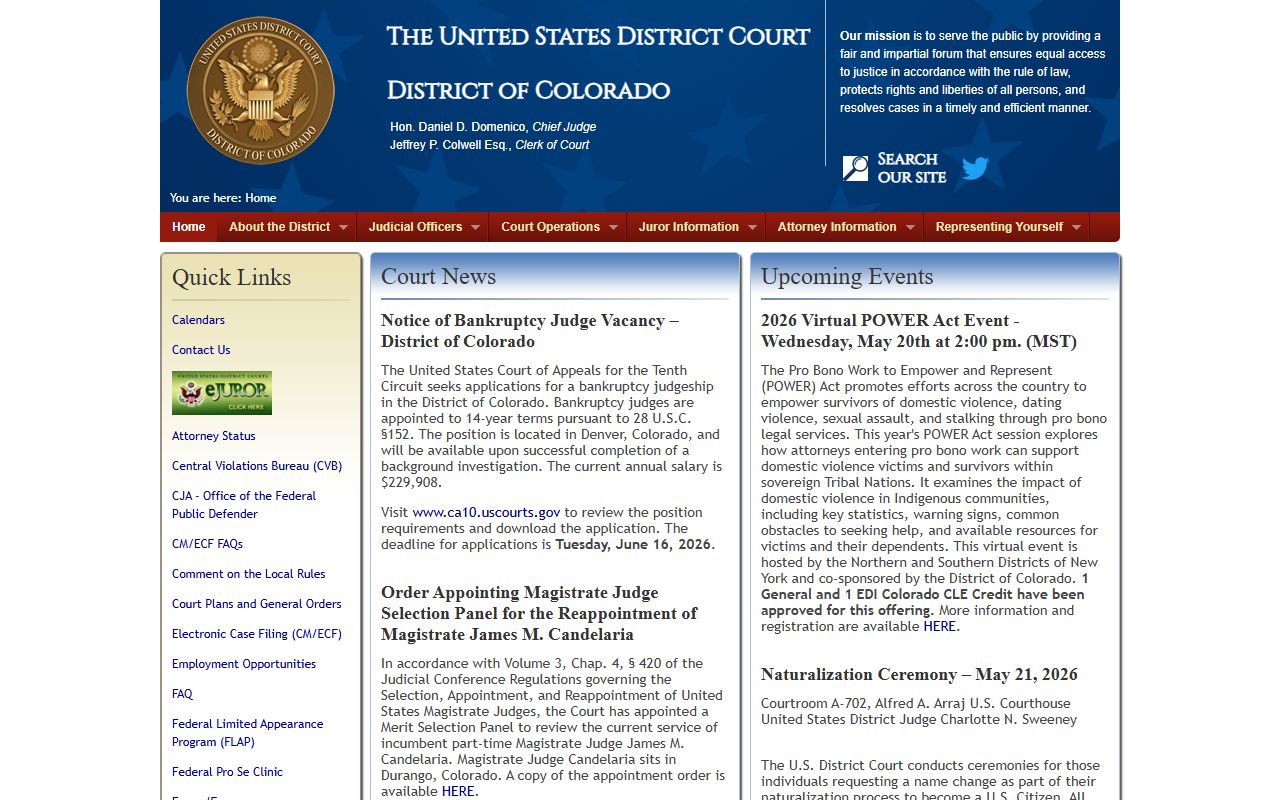
Federal filings from Douglas County go to that court and its CM/ECF system. Appeals from the District of Colorado go to the Tenth Circuit Court of Appeals.
Recorded Documents and County Records
Recorded land documents in Douglas County are searched through LandmarkWeb. The portal covers deeds, deeds of trust, releases, liens, plats, and other documents brought in for recording. A user looking for a recorded judgment lien, a deed of trust release, a quiet title decree, or a probate-related deed starts here, not at the court clerk. The county Clerk and Recorder runs LandmarkWeb under its Recording division.
The screenshot below shows the LandmarkWeb search page. The search options include grantor, grantee, reception number, book and page, document type, and date range.
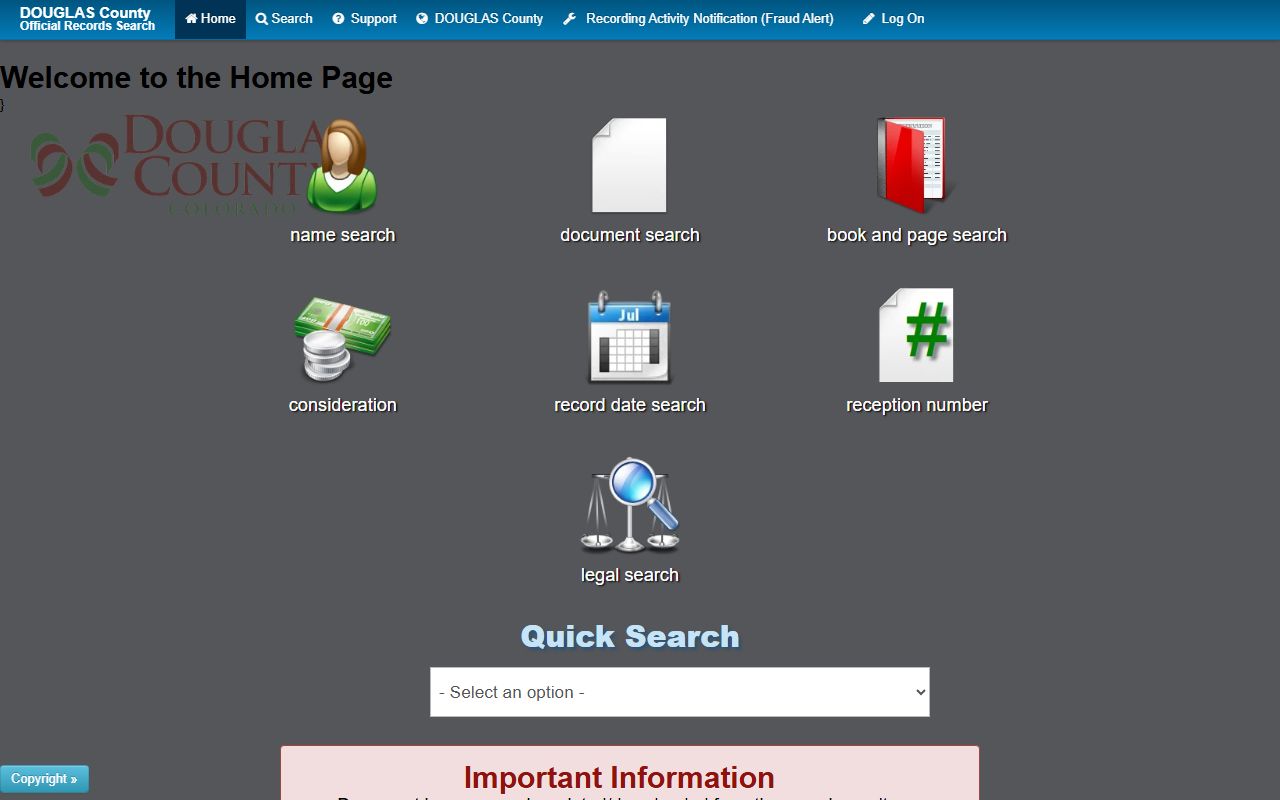
LandmarkWeb is not a court case search. It will not show criminal dockets, divorce filings, juvenile cases, or court pleadings. Use the state Judicial Branch dockets for those. The two systems pair well: LandmarkWeb for property history, the state docket for the court case that may have ordered the transfer. For non-court county records like budgets, contracts, or county policies, the Douglas County open records page is the front door for a CORA request.
Self-Help and Legal Aid Resources
Pro se filers in Douglas County have a fair set of free resources. The Colorado Judicial Branch self-help site posts forms for divorce, custody, name change, protection orders, sealing, fee waivers, small claims, and probate. The forms come with instructions. Colorado Legal Services covers civil legal aid for low-income clients. The Colorado Bar Association public resources page covers lawyer referral and self-help guides for common civil and family issues.
Criminal defendants who cannot afford a lawyer go through the public defender process. Eligibility is set by income, not by choice. The defendant applies in court, and the judge appoints counsel through the Colorado State Public Defender if the test is met. Victims in criminal cases get help from the District Attorney victim services unit, not the public defender.
Court staff can hand out forms and explain procedure. They cannot give legal advice. That line is firm. For strategy, a private lawyer, the public defender, or legal aid is the right call.
Frequently Asked Questions
Where do I search Douglas County court records?
Use the Colorado Judicial Branch docket search for hearing dates and case numbers. For full case files or certified copies, send JDF 4 to the Combined Courts clerk at 4000 Justice Way, Castle Rock. The Douglas County Combined Courts page links to both. Sealed, juvenile, and adoption files will not appear in public search.
Is the Clerk and Recorder the same as the court clerk?
No. The Douglas County Clerk and Recorder is a county office that handles recorded land documents, marriage licenses, elections, and motor vehicle services. The court clerk at the Combined Courts is a state office that handles court case files and court records. The two offices sit in different buildings and follow different rules.
Where is the courthouse?
Douglas County Combined Courts are at 4000 Justice Way, Castle Rock, Colorado 80109. The main phone is 720-437-6200. The site is west of downtown Castle Rock and is reached most easily from I-25. The Sheriff and the county jail share the same Justice Center campus.
How do I find my court date?
Run the state docket search and pick Douglas County. Set the date or a short range. Add a case number or name if known. If the case does not show, contact the clerk; the file may be sealed, too new, in municipal court, or in another county. Always double-check the date on a paper notice from the court.
Can I get a certified divorce decree?
Yes. Divorce decrees are court records and come from the Douglas County Combined Courts clerk, not the Clerk and Recorder. Use JDF 4 to request a certified copy. Pay the certified copy fee. The clerk can mail the decree or hold it for pickup. For full divorce filing steps, see marriage and divorce records.
How do I find an inmate?
Start at the Sheriff inmate page and use the linked public inmate inquiry portal. Search by last name, first name, or booking number. If the portal does not load, contact the Sheriff jail staff. For state prisoners, use the Colorado DOC offender search. For federal inmates, use the BOP locator.
Are warrants searchable online?
There is no fully searchable public active warrant database for Douglas County. The Sheriff warrants page is the official source for instructions. To confirm a warrant, contact the Sheriff or the court clerk. For a bench warrant tied to a court case, the court docket will often list the warrant entry under the case number.
What if I miss court?
A bench warrant, a bond forfeiture, or a default judgment can issue when a party misses a hearing. The fastest fix is to contact the court clerk and a lawyer right away. The court can sometimes set a quash hearing or a new appearance. Waiting makes the problem grow. Most warrants do not clear on their own.
More on the Douglas County Court Records FAQ page. For court dockets, see court dockets. For traffic citations, see traffic court records. For public records requests, see public records. For the clerk office details, see clerk of court, and for the district court write-up, see district court.